

 The Quiet Thread
Issue No.13 – The Garden, Part One: Ten Years of Rocks
Stories from our home at 682.5 metres above sea level
Written by Carlos
This morning we walked around the garden, as we often do, and it stopped us both for a moment. It is looking magnificent this year — better, I think, than we can remember it. There is bloom everywhere you turn, and in a week or two the peonies and the delphiniums, two of our great favourites, will be out as well.
We stood in the middle of all of it and found ourselves thinking back to the beginning. To what was here before any of it.
Which was nothing. If anything, slightly less than nothing.
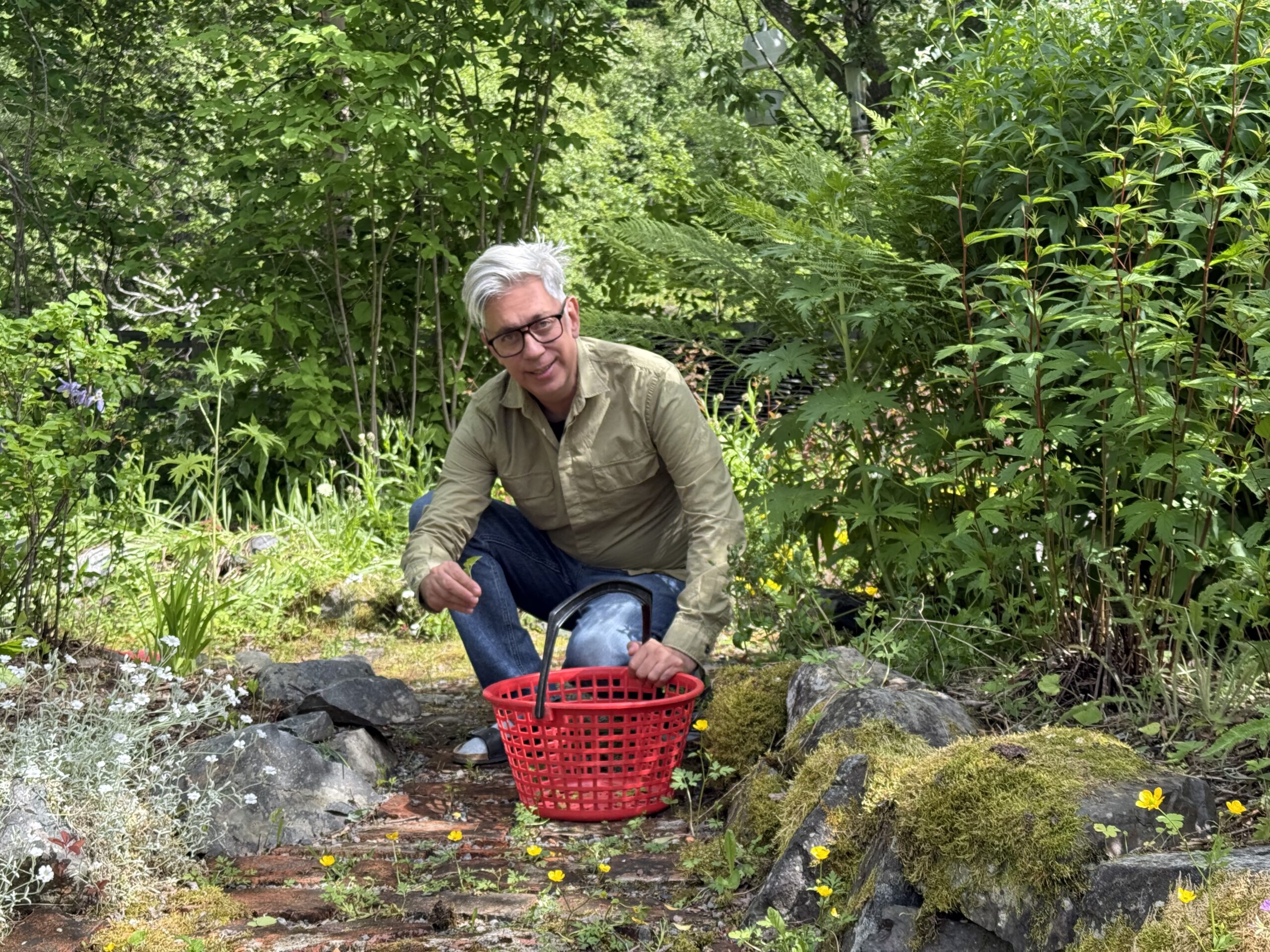
There was nothing here in the beginning. Twenty-seven years later, we have plenty to do.
The Weekend Arne Bought a Station
This was 1999. Arne first saw the station in February, on one of his trips up to visit a friend, and by the time he came home he had bought it.
He bought it without me. I was working in the city. This was before we had mobile phones — they were only just arriving, and we were in no hurry, holding out until 2002 — so there was no calling ahead with the news. He simply came home, and I asked how his weekend had been.
“It was wonderful,” he said. “The weather was beautiful. We went skiing. We sat in a café. I got so much done on my knitting. And by the way, I bought a train station.”
I asked him to repeat the part that came after the knitting.
He had seen it on a beautiful winter’s day, he explained, and it had appeared before him majestically, rising out of the snow — the most wonderful place either of us could ever hope to live. He was entirely sincere about this. He usually is. And Arne, when sincere, is almost impossible to argue with, so although I began the evening fairly certain he had lost his mind, I ended it, as I always do, completely won over.
He had not, it should be said, taken a single photograph. So for the next four months I lived with the house I had built in my own head, entirely out of his description and a generous quantity of snow.
Four Months Later
The paperwork was settled by early summer, and we drove up together to see it at last.
I had had four months to imagine the place. With no photograph to go on, I had built it entirely out of Arne’s description — the majestic building, the extraordinary light, the snow — and I had, if anything, improved on it. By the time we made the drive, I was looking forward to the most wonderful home either of us could ever hope to live in.
Whatever I was imagining, this was not it.
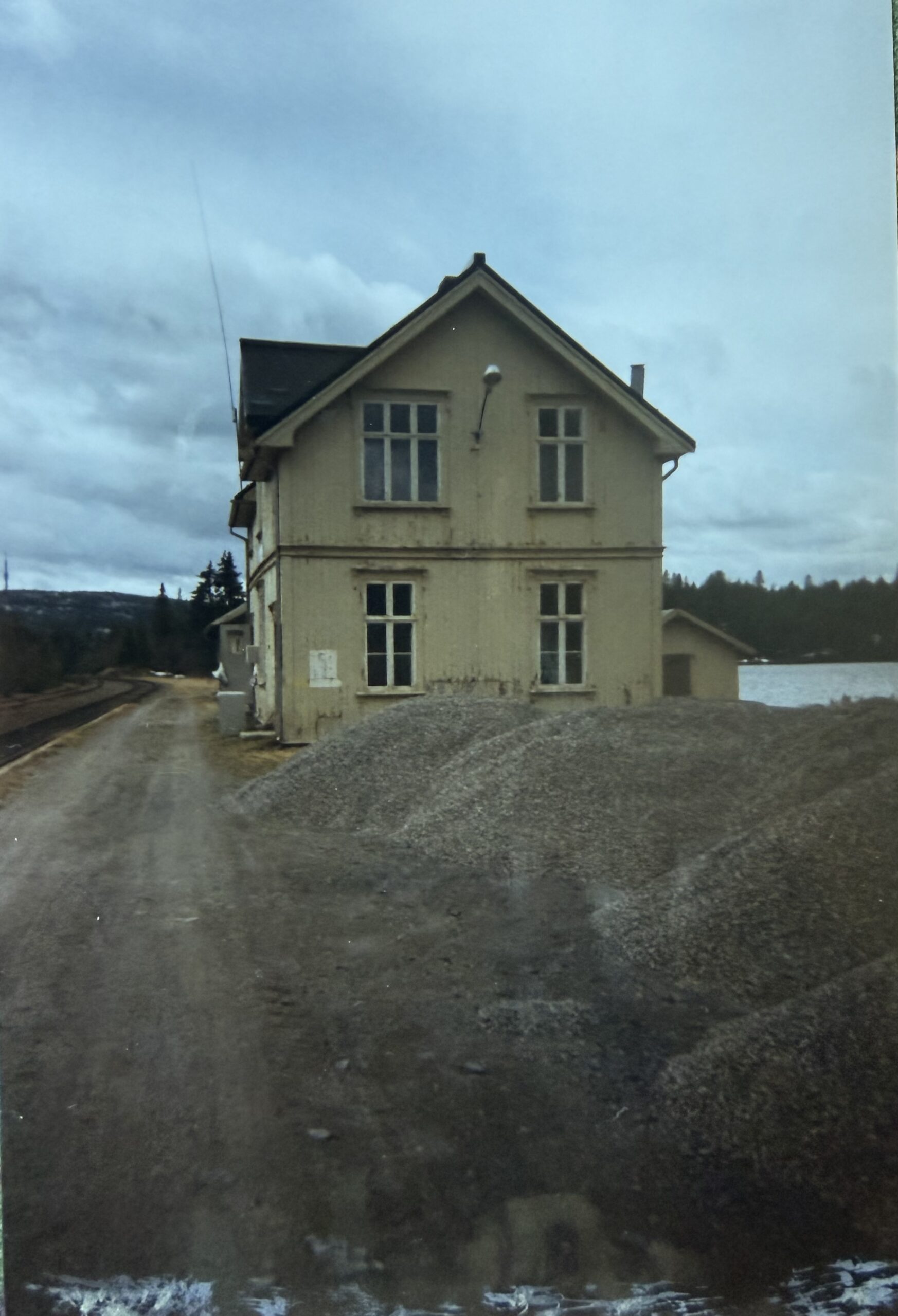
The station as we found it, 1999. As if the derelict house and the grey platform were not enough, there was also a pile of gravel — mercifully not ours, and gone within days.
It is a wooden house, and the paint was flaking off the exterior walls. There was no running water and no electricity. The house stood on a flat grey platform without a tree, a plant, or a single blade of anything growing — just grey, and more grey, and a lake just beyond it, where people came to fish.
I was standing in one of the rooms, taking in the full scale of what lay ahead, when the entire house began to shake. A car was driving past on the platform — down the long side of the house at considerable speed, around the corner, and back up the other side, without the faintest suggestion that anyone lived there.
Then it was quiet again.
I turned to Arne and told him I would never forgive him for this. I believe I meant it at the time.
But there we were. A grey, ugly platform, a flaking house, and cars using our property as a thoroughfare to the fish. Something, clearly, had to be done — and quickly. So the next day, we went shopping.
You Cannot Dig a Platform
We drove to the nursery and came home with thirty rose bushes and an assortment of other plants, chosen for no better reason than that we liked the look of them and knew nothing whatsoever about the place we meant to put them. Then we went to the mill for posts and planks, because the cars, it was clear, were not going to stop on their own. We carted it all up to the station, set it down, and stood there among the plants and the timber, ready to begin.
I took a shovel to the ground, leaned my full weight on it, and the shovel broke.
Arne, who does not accept that kind of thing lightly, fetched a long iron bar and went at the very same spot, with real determination, for the better part of half an hour. Then we both stood back to admire his progress: thirty rose bushes, a stack of fence posts, one broken shovel, and a hole in the ground roughly deep enough to bury a finger.
A platform, you see, is built with enormous care so that nothing will ever grow on it. This is an excellent quality in a platform. It is a less excellent quality in a garden, and it appeared to apply equally to fence posts, which were not going into that ground either.
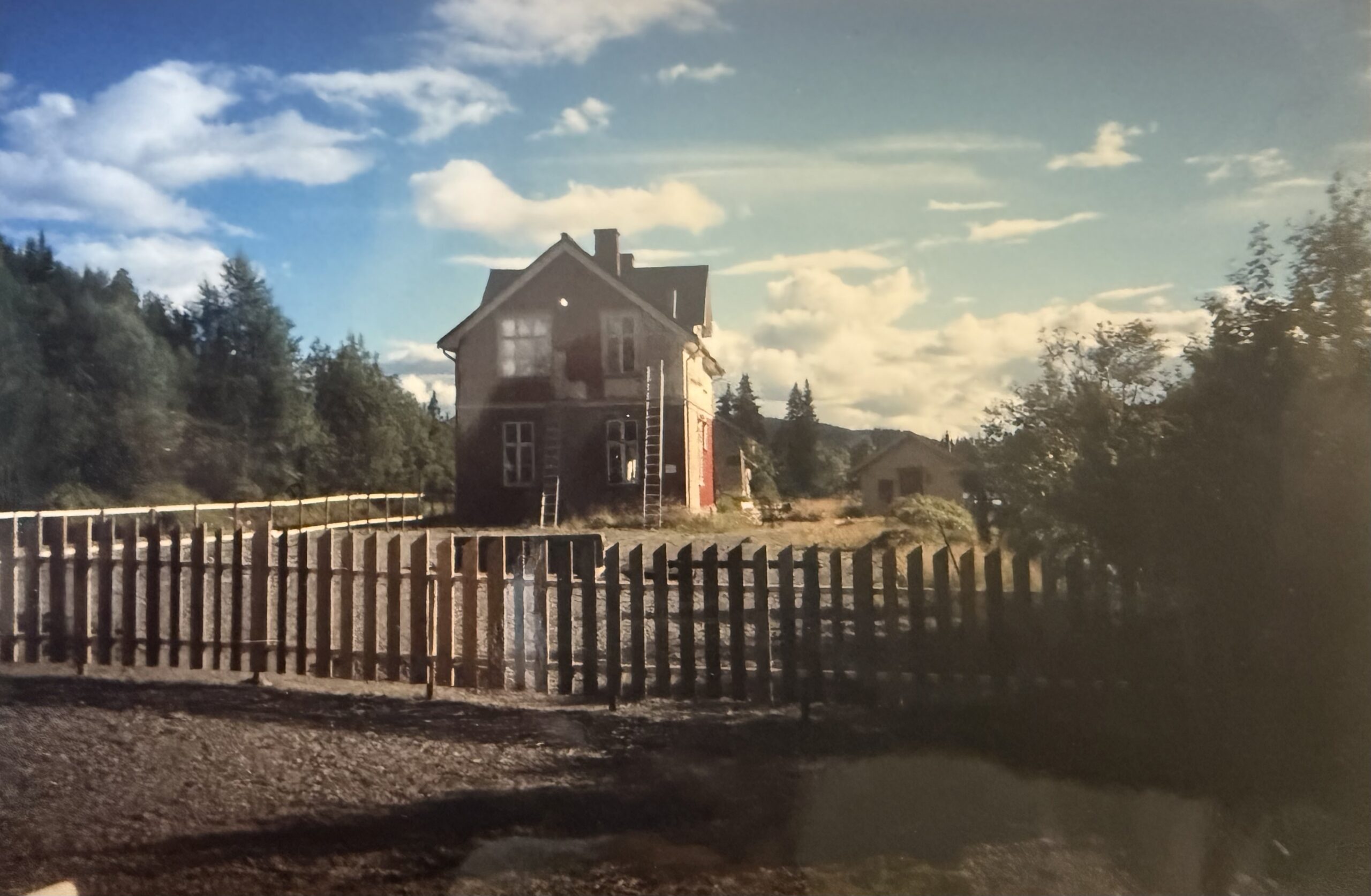
The fence, finally up. By now the house had had its first repaint — the flaking white was gone, replaced with red. The fence itself took the best part of a year: it turned out you can drive posts into a platform, once you work out how.
I said — not seriously, and mostly out of despair — that perhaps we should just plant the whole garden in flowerpots.
Arne thought about this for a moment and decided it was a very good idea. By the end of the evening my joke had quietly become the plan, and I, true to form, had gone from making it in sarcasm to defending it with my whole heart. If we could not put the plants into the ground, we would simply bring the ground to the plants.
Ten Years of Rocks
The method, once we had committed to it, was straightforward enough in theory. We rolled large rocks into rough circles — nothing straight, we agreed, with great conviction and absolutely no expertise, because nothing in nature is straight — and filled each circle with soil we carried in ourselves, bag by bag, since the platform beneath us was not about to provide any. We called them islands. They were really containers: rings of stone holding imported earth, perched on top of a ground that wanted nothing to do with either.
We placed the very first island at the far end of the property, because that is the first thing you see when you drive in, and even knowing nothing, we were already thinking about how the place would greet a visitor. Had we known what ten years of carrying rocks does to a back, we would have placed it considerably nearer the house. We did not know. We placed it about as far from the house as it is physically possible to place anything on our property, and we have been walking the distance ever since.
And then we carried rocks for ten years. I want to be clear that this is not a figure of speech.
We began with the stones closest to hand and got through three or four wheelbarrows in the process, a loaded wheelbarrow being, as it turns out, not built for this sort of treatment. The one that survived was, of course, second-hand. Arne’s mother — the original Queen of Thrifting — turned it up for a hundred kroner: a professional model, built for Statens vegvesen, the Norwegian roads authority, and therefore designed to be treated appallingly by people doing more or less exactly what we were doing. It refused to break. It is still with us, retired now to gentler duties, ferrying leaves and weeds down to the compost.
When we ran out of stones near the house, we crossed to the far side of the lake and brought more back in a small Mitsubishi pickup we bought for the purpose. The truly enormous ones never made it onto the truck at all — they were simply too heavy to lift — and those we rolled, a little at a time, half an hour of effort here and there, over days and sometimes weeks, until at last they sat where we wanted them. I will not pretend we always remembered, by the end, why a particular rock had seemed worth it.
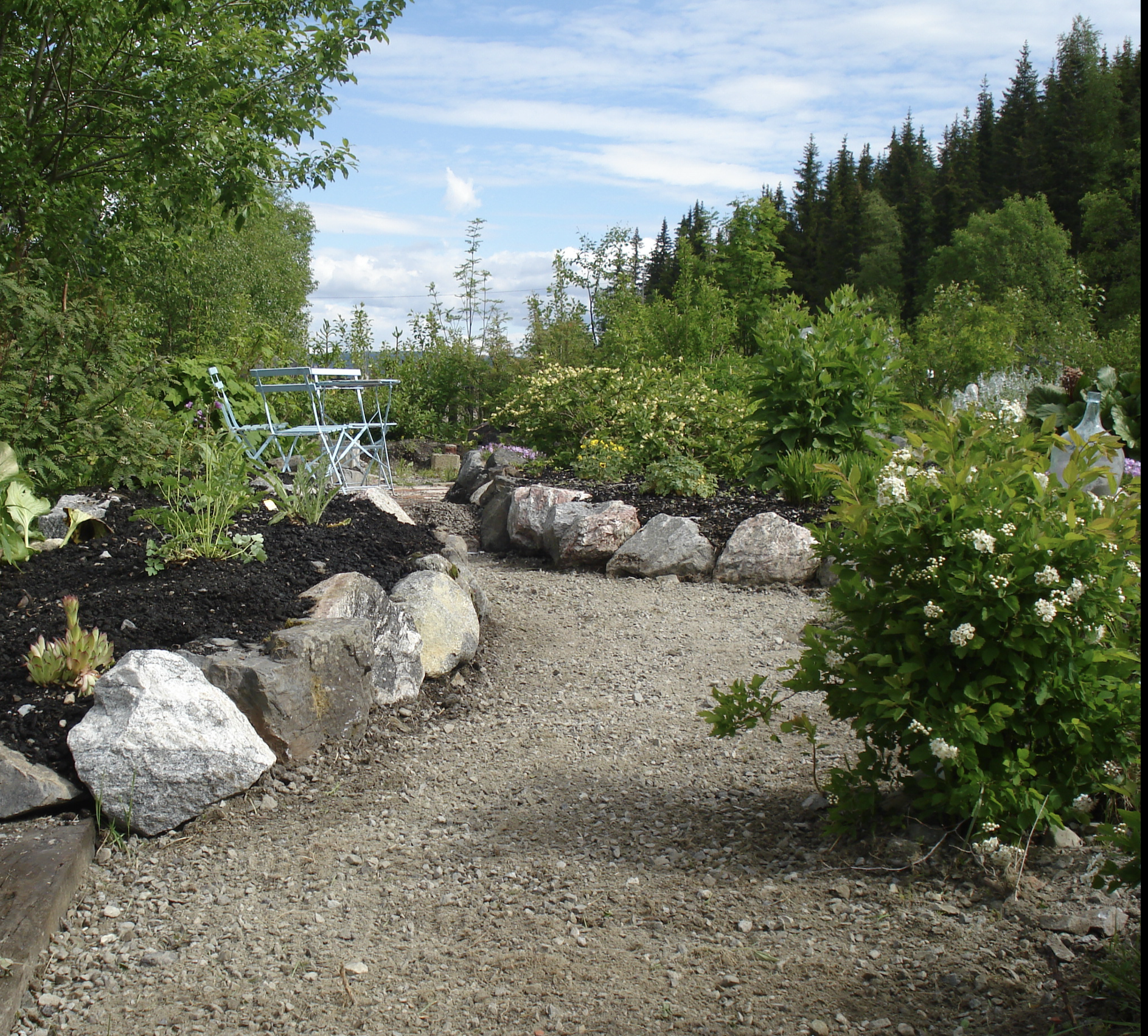
About five years in. The islands built up, the rocks in place, the first plants taking hold — and the old platform still showing through in the middle.
The bricks were Arne’s doing entirely. We were perhaps three years in, with maybe a third of the rock garden built and a great deal of carrying still ahead of us, when I came down one day to find him at the edge of the lake with Lyda — our sheepdog, who loved nothing in the world so much as the sight of the two of us working, and who was beside herself that something was so clearly afoot. Arne was crouched over a small pile of old bricks. He was, he explained, saving them. Then he showed me what he had in mind: two laid one way, two laid the other, a pattern already fully formed in his head for paths we did not yet have.
He had got the idea in Klaipėda, on the Lithuanian coast. We had been there together, walked the same streets at the same time, and to this day he will tell you those streets were paved in beautiful old brick. I have no memory of any brick whatsoever. We have discussed this at length, on several continents and over many years, and have got precisely nowhere — because the trouble is that somebody has to be right. One of these days we are simply going to have to go back to Klaipėda and settle it.
The bricks in the lake were the first of them — the remains of a chimney, we think, from a house that had stood there long ago. When the lake had no more to give, we remembered a derelict house that had collapsed in the woods, and went to fetch its bricks in backpacks. We broke two backpacks doing it. The one that survived was, naturally, the old one — a metal-framed pack from the loft of Arne’s childhood farm, most likely his great-grandfather’s. We filled it, took turns carrying it the half-hour home, and discovered along the way that it holds exactly six bricks and not one more.
Believe it or not, for a good few years this was simply our life — looking for rocks in the forest and bricks in the water, and thinking it an entirely reasonable way for two grown men to spend their days. Some people called us original. Others, eccentric. The garden makes a strong case for delightfully eccentric, which is the version we prefer.
And all the while we carried, the garden was quietly beginning to live. In the warm gaps between the rocks, where there was almost no soil to speak of, houseleeks settled in and spread — small green rosettes that ask for nothing but a stone to sit on and a winter to sleep through. We had not especially planned them. They simply recognised the place, which was rather more than we had managed to do. Slowly, between one summer and the next, the grey began to go green.
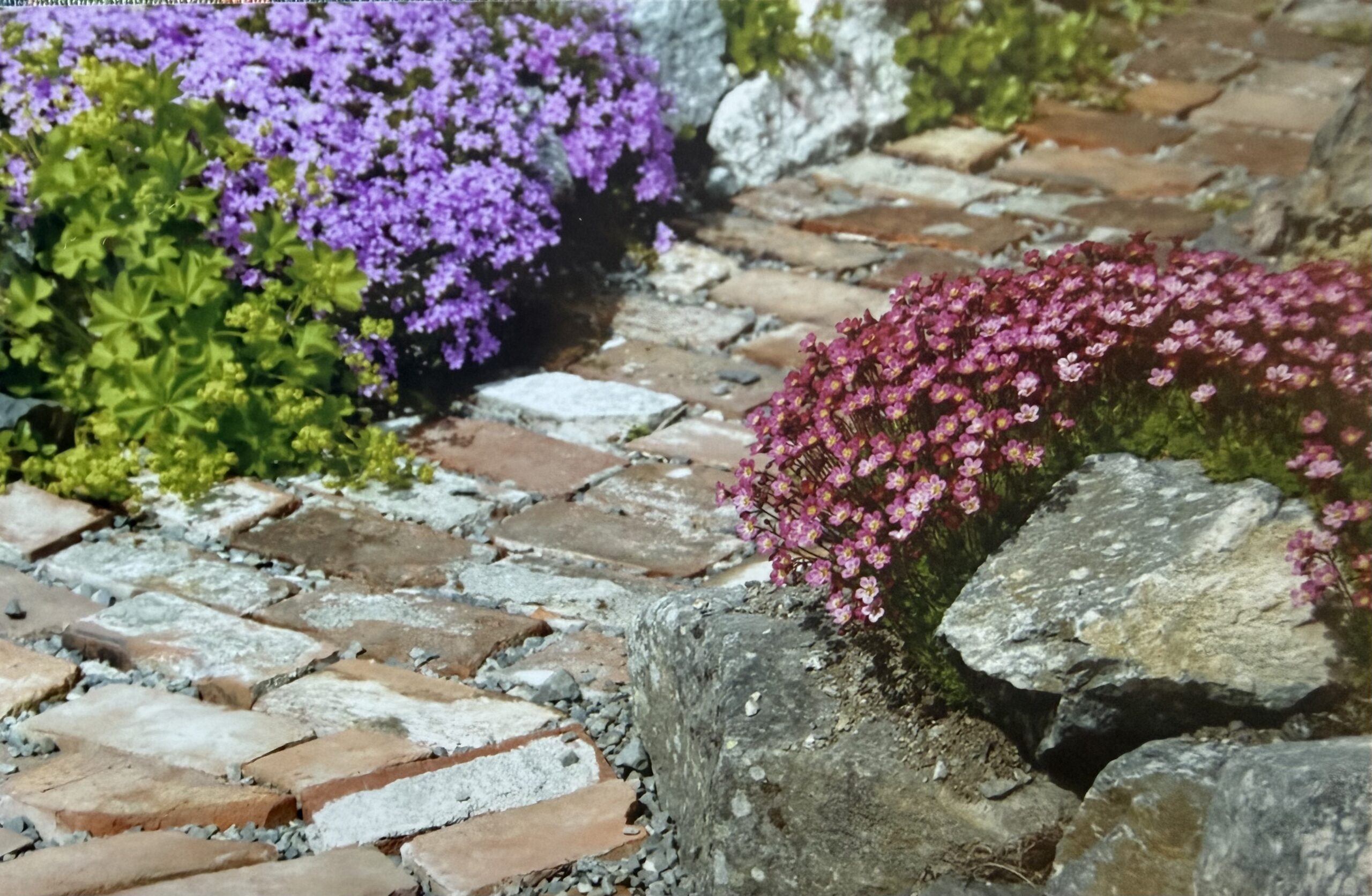
Bricks and stone we carried in by hand, years on — the moss and the alpine flowers grown in over the top, as though it had always been here.
The Last Rock
After ten years, the rock garden was finished. Or very nearly — for there is a story about the last rock, and it remains one of my favourites.
There were roadworks not far from us that summer, and among the rubble we had spotted an enormous rock, far larger than anything the two of us could ever have moved on our own. Arne wanted it. He wanted it the way one wants a thing without being able to fully explain why — as a kind of trophy, perhaps, for ten years of all the smaller ones. We asked the road crew whether they might bring it in for us, and they did, lowering it into place with a machine in a single afternoon, and free of charge.
Arne looked at it for a moment and announced that now this one was here, it was the last rock.
And it was. After a decade of carrying every single stone ourselves, the very last one arrived as a gift — the one rock we did not have to earn.
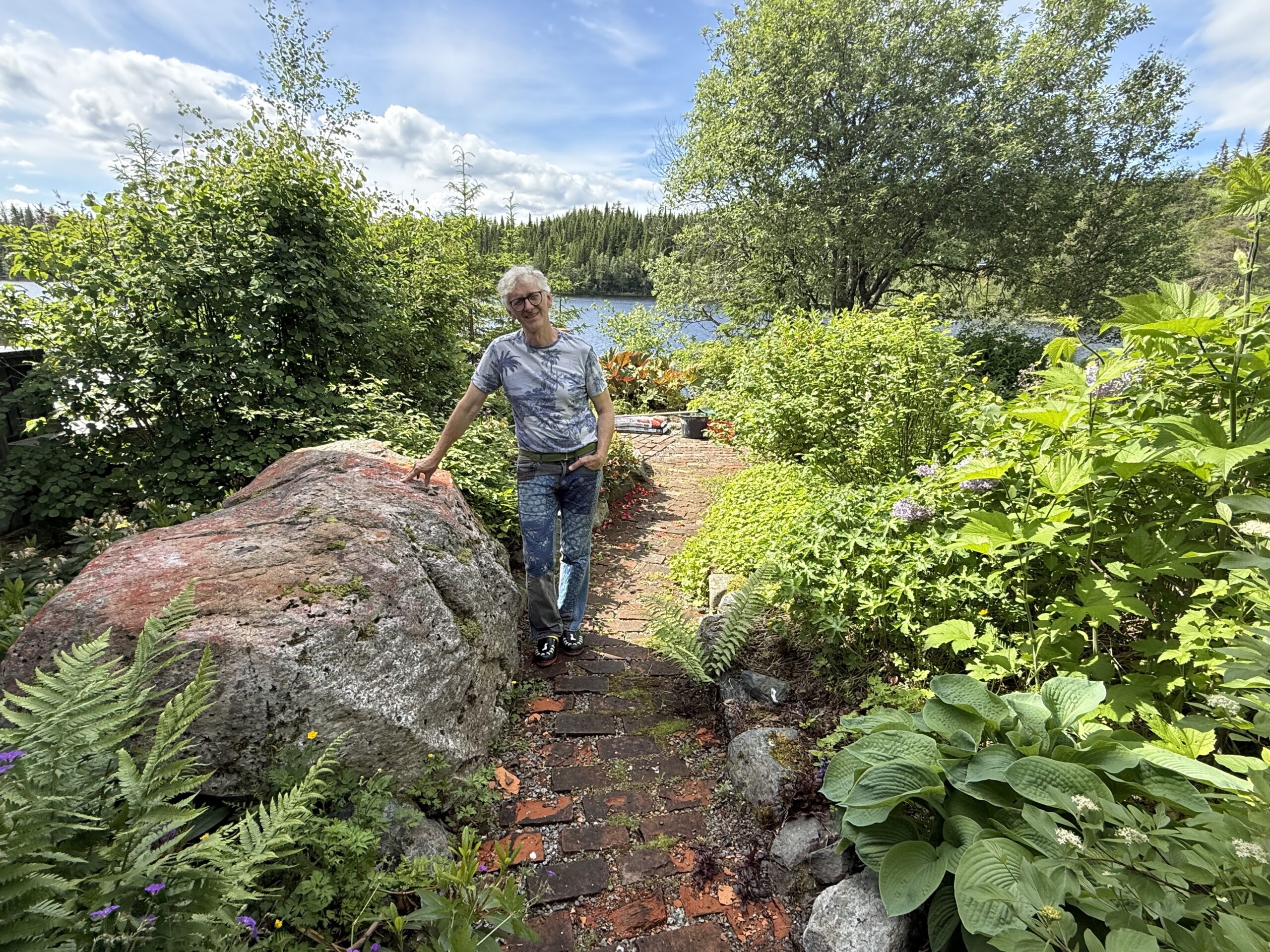
Arne and the last rock — the only one we never had to carry, and the one he is proudest of.
Which brings us, more or less, back to this morning: the two of us standing in the middle of a garden that was once a grey platform you could not get a spade into, watching it come into bloom on top of every rock we ever carried, and the one we did not. We are, as we are every year about now, quietly amazed that any of it works at all.
How we learned what would actually grow up here — and what the garden taught us, slowly, in return — is for the next part of the story. We will come to it in two weeks, by which time the peonies and the delphiniums should be out and, if the weather carries on as it has been, hot by day and raining every evening, we may well be living in something closer to a jungle.
From our railway station in Valdres, where the garden is lovely today and will be lovelier still by the time we write again.
ARNE & CARLOS
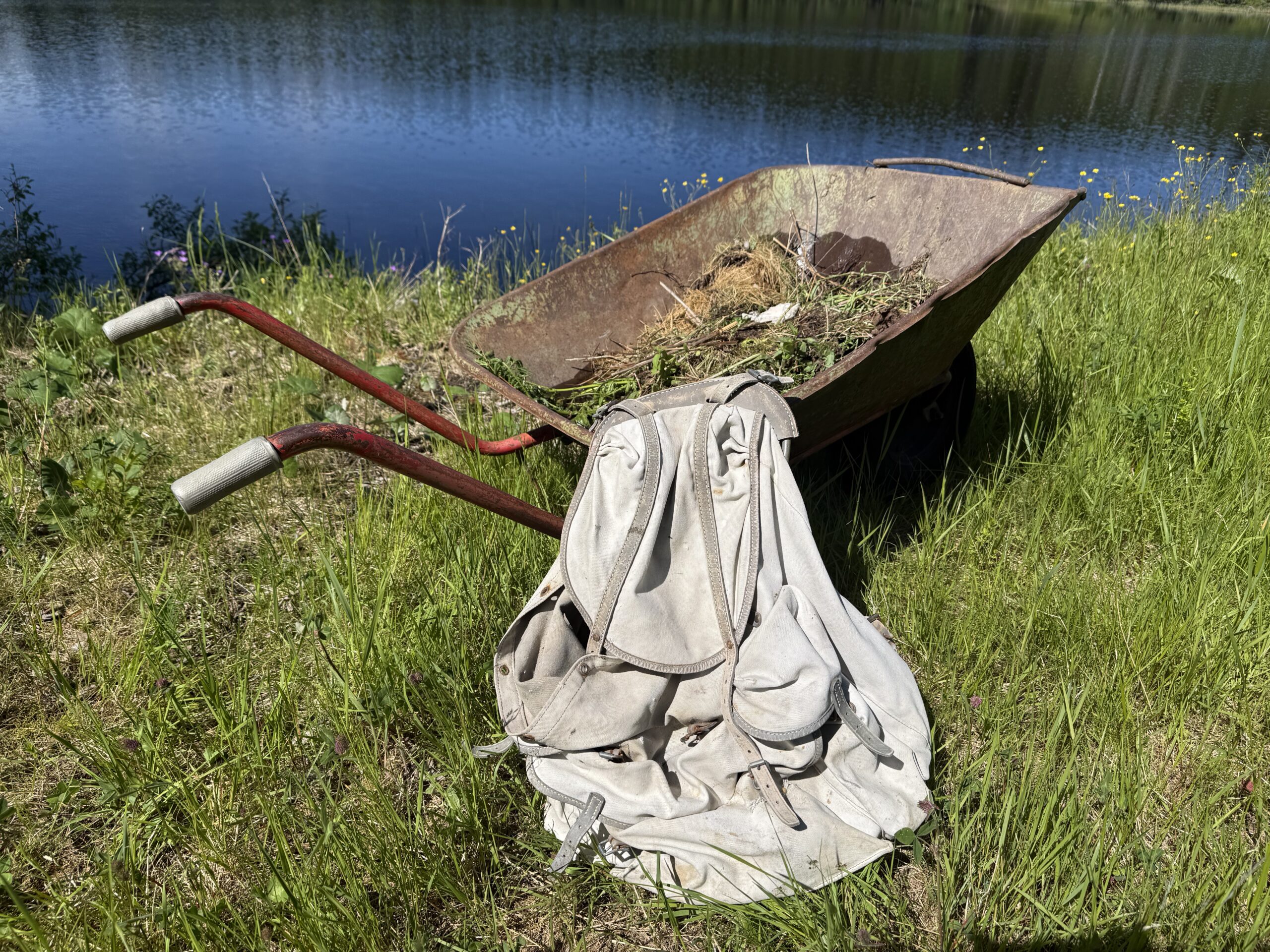
The two survivors, still with us after 27 years. We went through plenty of newer, lesser things along the way — but the wheelbarrow and the backpack, both handed down, simply refused to give up.
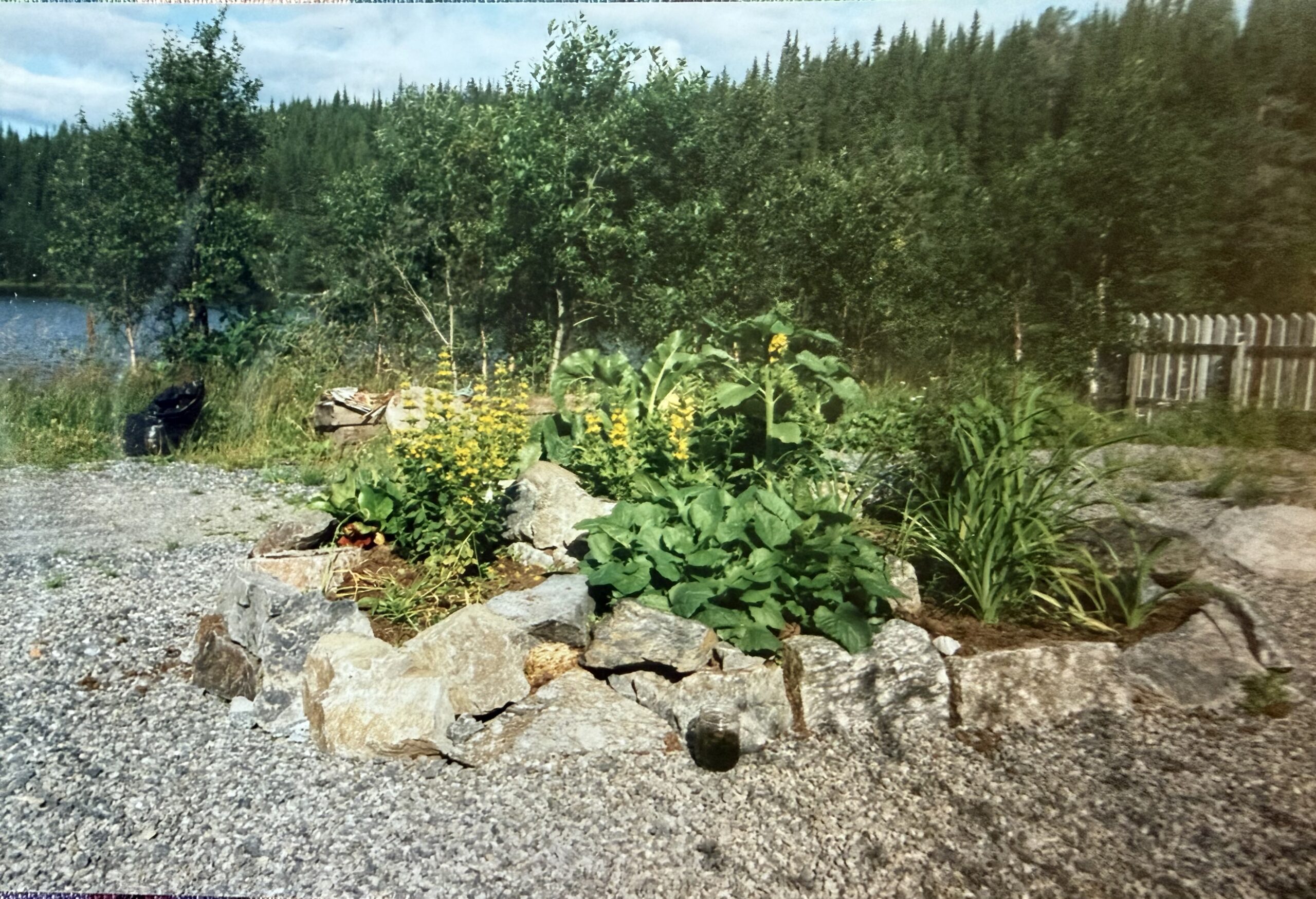
An island a few summers on — earth held in a ring of rock, and finally something growing in it. We had brought every stone and every spadeful of soil; the yellow came on its own.
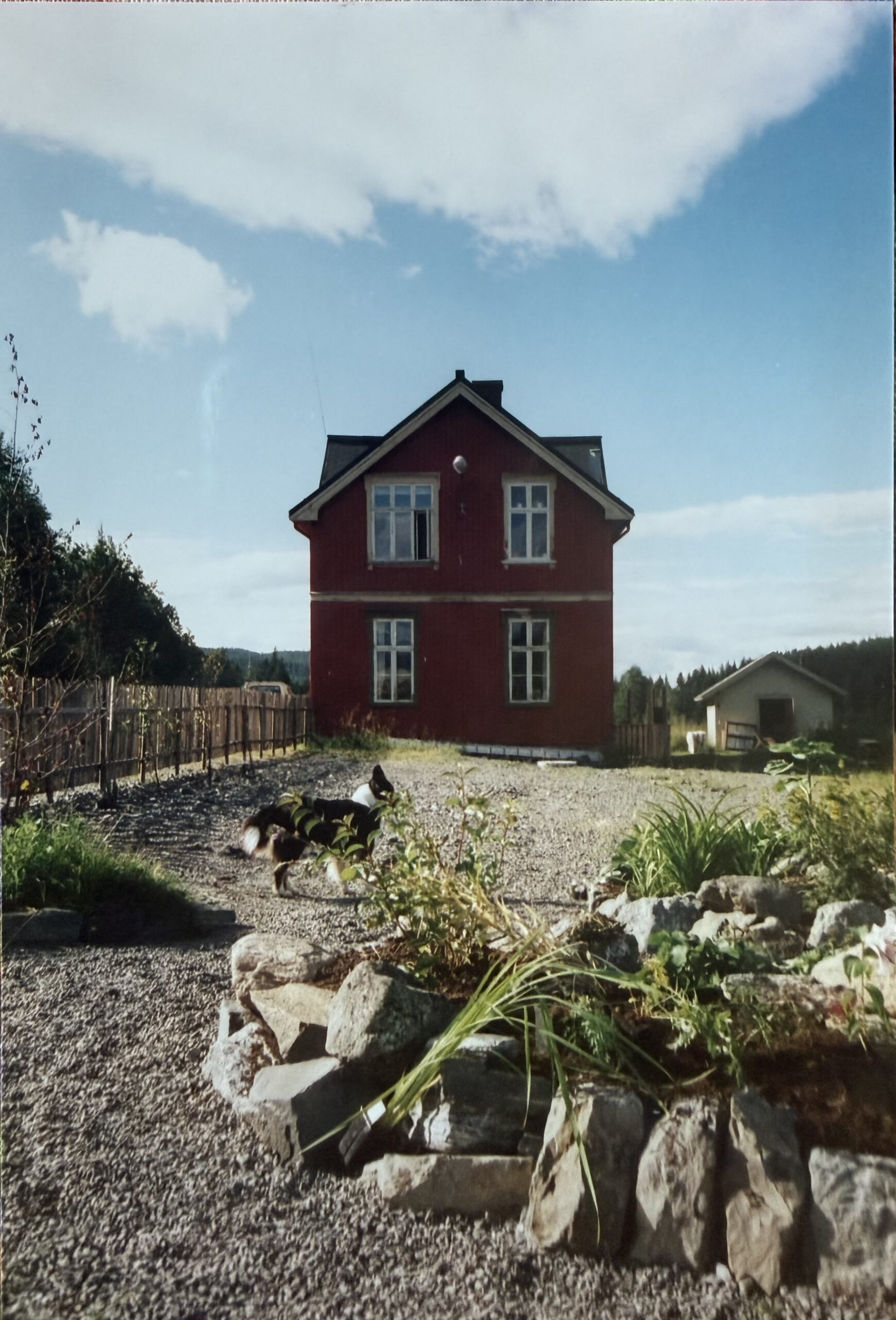
The red house, the gravel, and Lyda on patrol — happiest, as ever, when there was work afoot. The beds were beginning to take; the platform was slowly losing the argument.
Skip to comment form
What a delightful story. I never understood it when you talked about a platform. Now of course I do. It is astonishing that your garden originated from that massive amount of work. And I agree with Arne about the final rock. So beautiful and a crowning glory to all your labor.
I had tried several times before and, unfortunately, encountered people who took advantage of me, leaving me disappointed and discouraged. When I learned about Priest Alaska, I decided to contact him and share my situation. For the first time, I felt truly heard and treated with understanding. I decided to take a chance after receiving guidance from Priest Alaska; at the time, I never imagined how much my life would change. I longed for a major financial breakthrough, so I chose to remain hopeful and follow the advice I received. When I finally discovered that I had won $80 million in the lottery, I was completely stunned and overwhelmed with emotion. It was a moment I will never forget. The news brought immense happiness to my family and me, opening the door to opportunities I had previously only dreamed of. I am deeply grateful for the encouragement and guidance I received during that time. After enduring so many prior disappointments, I am simply happy to find myself in a much better situation today. Thank you, Priest Alaska, for the support and guidance you provided throughout this journey. If you are interested in receiving spiritual guidance regarding your hopes and goals, you can contact Priest Alaska to request his services. email: alaskaspellcaster44 @ gmail. com
I came across Priest Alaska and decided to seek his guidance. I shared my story openly and explained how much I wanted my wife and our marriage back. He listened patiently and made me feel understood when I was at one of the lowest points in my life. With time. After Priest Alaska did his work. I started noticing changes in my situation. The distance between my wife and me began to fade, communication became more frequent, and the coldness that had existed between us gradually started to disappear. Then came the moment I had been hoping for my wife came back to me and was willing to give our marriage another chance. Having my wife back in my life means more to me than I can put into words. We are now taking things one step at a time, rebuilding our connection and creating a better future again. My experience reminded me that when a relationship is going through a difficult season, it is important not to lose hope. Seeking guidance and spiritual support can help you find a positive way forward. If you would like to contact Father Alaska, here is his information. Email: alaskaspellcaster44 @ gmail. com
I read about Priest Alaska online that he has helped a lot of people revive broken marriages and relationships. I decided to reach out and from the beginning I felt welcomed and a little bit calmness struck me again my nerves was so calm immediately I knew I was on with the right person who can help me turn my marriage around for the better. Following the guidance of Priest Alaska I noticed positive changes, communication between me and my husband gradually improved, misunderstanding was resolved. Today, I’ve reconnected with my husband and we are committed to moving forward together. For anyone going through a difficult period in their marriage or relationship, seeking trusted guidance and support can be an important step toward healing and reconciliation. I would like you to learn about Priest Alaska Services visit his Email directly to alaskaspellcaster44 @ gmail. com
🥰
I’m so moved by this story. I never imagined your beautiful garden started from a place where nothing could grow. Thank you for sharing this journey with us. I love your stories, and I especially love the humor you and Arne share.
Great story! I love that you guys use all of your creative energy in everything you do:)
Arne e Carlos; Parabéns pela história maravilhosa de vossa casa!
Li e fiquei muito feliz em saber dos detalhes da construcão desse jardim maravilhoso, que reflete a alma e o amor de vocês dois.
Gosto muito de cuidar do meu jardim também e vocês trouxeram-me muita alegria no cuidado que vocês têm com vosso jardim
Obrigada por compartilhar vossa história e que venham mais !
This story brought me to tears! You are two eclectic (not eccentric) gentlemen who possess extraordinary vision and determination. The transformation from derelict train station to exquisite home and garden is a singular labor of love. Nestled into the lake location, your living space brings me so much joy…and I’ve never been there! May you experience many more years of blessings in Valdres!
Wow!! what a beautiful story and what a beautiful house and garden you have built.
You should be so proud of yourselves. Love it ❤️.
Beautiful story of vision, commitment and hard work. Thank you
Loved this great story of your home and garden. The hard work and perseverance has produced something to be proud of and encouraged others! How many other pajama gardeners are now building their gardens! Hats off to the best pajama gardeners!
Now I know why Arne was so tired in the videos. What a project!
You two are such beautiful souls. And so inspiring! Thank you, Carlos, for sharing. ❤️ I both laughed, and cried. ” Lyda on patrol — happiest, as ever, when there was work afoot” … heart-sore with joy.
Gives a whole new meaning to the concept of a rock garden!
loving your garden story and how your vision stories completed. looking forward to more stories about your home.
Merci beaucoup pour cette belle histoire !
Quel courage, quelle patience et une si belle réussite à la fin 😀
Simply beautiful and thank you for sharing this story of perseverance and joy!
wow! you two are a great team. you have transformed an old railway station into a beautiful home and property.
What a beautiful story of care and dedication and what a lovely home you now have all these many years later! Reading this piece was so uplifting, such a great success story of a restoration project that challenged you along the way but let you with one of the most unique homes I’ve ever seen and clearly so many good stories. Looking forward to the next issue, thanks for sharing!!
I’ve followed you since I met you on you tube during the Pandemic 2020. I adore you both.learning this beautiful story makes me happy. The determination, the desire, the design. All of it. Thank you for retracing the steps as to where you are today. Much love for you both.
What a lovely read this is! Thank you for sharing! . . . . By the way, how long have you used it as a residence to live in?
Oh, Carlos, you wrote your story as if you were speaking to me directly – it was as if I could see and hear your emotions and truly understand your and Arne’s experiences. Beautifully written and a treasure for us all to know more about you and Arne. Thank you!
Thanks for sharing the journey, one rock at a time! I suppose the property was waiting for two artists with vision and perseverance to allow it to bloom with life. You both should be proud!
What an incredible journey. The hard work and sweat and likely a few moments of why are we doing this again. too. You can now stand back and marvel at it all. The house is so beautiful, the gardens devine. It started with a vision.
It is truly a labour of love.Congratulations on what you both accomplished.
What a journey! Arne saw lemonade where you saw sour lemons! Gorgeous!
Thank you for sharing your wonderful story that was very well written. You have both made a beautiful home together and it will keep on rewarding you with its beauty for many years to come.
Can’t wait to read the next chapter.
Jane (from 🇨🇦)
I enjoyed the story I can only imagine the work you both put in you have a beautiful place now I can just see your face carlos when you first seen the place I can hardly wait until the next part thanks for sharing your story
Your commitment to the future, while savouring the accomplishments of the present, is inspiring.
Beautiful work, you two. And, WOW, that last rock is amazing!
Lovely post! I am looking forward to your second installment. What you have accomplished with your garden is amazing!!!
PLEASE – PLEASE – PLEASE…as another commenter stated, write a book and put all these (and more) pictures in it! I would love to have it in my collection. You both inspire me with every blog post and podcast. Thank you!
Please compile your writings and photos into a book! There’s so much beauty in your souls that I want to be able to keep the stories with me forever.
Thank you for sharing. Love you both forever.
I loved this narrative of the development of the home and garden you have developed over the years. Beautiful story and writing Carlos and I can totally see Arne just having to have that station-his vision came true.
I love the story and photos of your home. It’s made beautiful. Is Lyda a border collie?
Thank you for writing and telling us all about your converted home. Jane
I adore gardens in unlikely places and this is a wonderful account of the making of one – I especially liked the bit about how the houseleeks crept in by themselves, and you just welcomed them in and let them be. Looking forward to the next instalment – it will take a place in my collection of garden-making stories alongside the story of the making of Derek Jarman’s garden around Prospect cottage, although happily – yours is a more joyful tale – long may it continue!
What a delightful story – full of your gentle humour. You have both created a bit of paradise with love and hard work.
Marie UK
Arne and Carlos, I was completely captivated reading Part1 of your garden and home history. I laughed really hard as I imagined Arne in his determined and convincing voice making the argument for his purchase of a train station (even if dilapidated). Carlos, your first trip to your new home should not have surprised you in the least bit. Given Arne’s propensity for other people’s trash into his delightful and often very lovely treasures. His creativity and ability to see wonderful things grow from nothing is a true gift and I love to see him in action.
I look forward to reading part 2. Carlos you should write more of your adventures and publish a book.I would be one of your first customers.
i loved reading this so much – Thank you! I love the history and memories. Your garden is well deserved for such hard work! Beautiful story from two wonderful people!
xo
such a wonderful story.
thank you for sharing it.
Absolutely Beautiful, Gentlemen!💖🤗 You have worked so incredibly hard to create your dream home!! It is so inspiring! I too move rocks and bricks at our new home in Eastern Ontario, to build my own little patch of Paradise. So, I ask…is it truly the last rock??? I always seem to find more to move, rearrange or add! 😉Thank you Carlos, for taking the time to write about what you have done, and include the pictures.
What a magnificent telling of the beginning of your home; I was so touched and could see everything in my minds eye. The pictures along the way were just as I might have imagined. What I can’t begin to fathom is your shear dedication to make this property and home of love into the inspirational and zen place that it is today. You two are amazing, truly amazing. I’m so looking forward to the next part of the story.
Such a lovely story. I read it as I enjoyed my first cup of coffee, here on my porch in the Highlands of Maine. The story brought happy tears.
“ He wanted it the way one wants a thing without being able to fully explain why …” This line took my breath away because I have known it. How it smells, how it feels and the glory when that want is fulfilled, by happenstance, insistence, serendipity and hope.
Thank you for the stories of your lives together.
Wow! A true labour of love, hope, trust and belief, your garden ,and house too i presume! It reinforces the magnificent spirit of humans when they want to, really want to, achieve something( turn their thoughts and ideas into reality), as you two have done with your garden. What an inspiring story and so beautifully written.
I really really enjoyed reading this story 🙂
You two are an inspiration !
I’ve admired your beautiful garden for the many years I’ve watched on youtube and seeing the start of it’s journey is wonderful.
We are retiring this year to our 10 acres of Australian bushland with very hard clay soil with nothing but grass and gum trees and will need to garden above the ground too.
This is a beautiful story of how you take a building and a vision and turn it into a home. Love it.
I so enjoyed the story as it brought back so many memories of our own gardening experiences. 50 azaleas in the front yard. Bricks carried from a burn down art colony for a walkway. The 250 year old house with a cracked stone foundation, broken windows and a cow fence and which eventually enclosed the garden of my dreams. We have left each of these homes and gardens so I don’t know if they have survived. It is wonderful you guys get the enjoy the fruits of your labor. Mine are in my head of what was and could be. I never regretted a minute of all the work. Thank you for reminding me. Your home is beautiful. Keep writing! ❤️
Carlos you paint a beautiful word picture with your descriptive writing. You describe the emotion and feeling of what you were doing way back at the beginning of your gardening journey and I felt like I was observing you and Arne build your garden stone by stone, brick by brick. You have embraced the old saying ‘a journey of a thousand miles starts with the first step’ and to see how far you have come on your journey is truly inspirational. I love your writing. Xo
Thank you for sharing this lovely story, so well written with humor and sincerity. This particularly reached me at a moment that I needed inspiration. My home was recently very damaged by a water break. I am trying very hard to get it back together, but the stress and work have taken its toll on me. Thinking about Arne laughing over rocks, and Carlos fussing about Arne over rocks, was a gentle reminder that hard work does pay off in the end. Sending you Good Karma.
Oh dear! My husband and I bought an old house much like this, ( I think he and Arne have a lot in common) and for 30 years we tended it, much like your garden. Our children were small and on occassions we would ‘lose’ one down a hole in the garden. Their friends who came to stay complained of ghosts ,but they seemed friendly most of the time. The children grew and we grew old. The house got too big and we sold it and moved to an island about 70k from the city. Now at 80 I am starting on a tropical garden. Gardens can give so much pleasure and precious memories can’t they?
such a lovely description of hard work and perseverance and best of all, a Vision.
Congratulations to both of you, you created a piece of “As it is in Heaven”.
The story of your home and garden is wonderful! It truly shows what can be accomplished with work and determination!!!! Sometimes it is a special rock that makes the garden and sometimes it is a special plant or tree or sometimes it is a piece of art or a sculpture that completes the garden. I love watching the two of you and reading about all of your adventures. Hopefully, one day I will get to meet the two of you. Thank you for sharing your lives and the things that you love with us. We love you for including us in your lives.
Wonderful pice of writing. ❤️
Absolutely amazing and beautiful!
You both deserve a standing ovation for all the work you’ve done.
I love this story! And I love that you have been able to grow with your platform garden. You two are so inspiring, I can’t wait to read the next installment!
Hi Carlos
The life you & Arne have created seems to be infused with magic; telling your story in such a lovely way helps to illustrate the fact: YOU are the magic; both of you. Your determination to follow your vision and embrace each challenge is where your power lives. Taking a more difficult path in life produces untold riches. Thank you so much for sharing your story.
I loved reading your story and looking forward to the next installment!
Gardens and old houses (train stations) will always be a work in progress.
Mayme from Michigan in the US
Arne and Carlos, I loved this so much! Thank you for sharing! ❤️
What a wonderful piece of writing Carlos I was transported to your garden. Before we bought our house last year, a fire had burned down the original 1780 house that used to stand where our house is now. When digging around an old stone wall this spring we found all the old hand thrown bricks from the original chimney. The few which remained in one piece are now garden bed edging and a small path. It’s nice to keep a small piece of history alive. I’m envious of the final rock!
Oh Carlos, you are such a wonderful storyteller!
I have heard you tell this one many times, yet the way you write brings so much detail,humor and love to the story it’s like hearing it for the first time.
Thank you for always taking us with you and Arne . I feel so privileged to share a small part of your life’s adventures and inspiration.
I’m ready to lay down some bricks now !
Lots of love ,
Eva
Thank you for sharing these wonderful memories! My mother has been moving rocks around for the past 50+ years since my parents moved here and built their home. After the passing of my father 3 years ago, I came to live and be her care giver. Now she is 92 and is still moving those rocks around. She says it gives her a purpose to get up everyday. She spent this morning with her rocks. I enjoyed reading and seeing your rocks. Knit happy!
You two are amazing’! So well written. Love having your life updates. I have a birthday close to Arne’s. Missing the long nights. Now having moved from Minnesota to North Carolina. I also have a difficult garden challenge, a former city alley. Three years on it is evolving. Planted over 32 trees and many native plants. The Japanese call it a “Pocket Forest.”Whatever I can acquire for free. Luckily I have many generous friends & neighbors. Just turned 75 and the back is barking. Slowly carrying on. No rush, right? Can’t wait to see you both on the Danube!
I love your story telling skills as much as I love your gardening & knitting skills, you two are an original, ecclectic and lovely pair, and I use all of those words in a loving way! Looking forward to part two. ☺️
What determination, and what wonderful success for your efforts! A great story to tell – I look forward to the next chapter. Carlos, you are a good writer. BTW: Of all the pictures of you two, the one of you two crouched in the garden is one of my favorites.
Fabulous! I adore the descriptions of your adventures and feel that I am walking beside you. What a pleasure. X
It’s a magnificent rock! Thank you for this memoir!
Happy Summer!
You two are so inspiring! There are garden-lovers of all sorts and degrees of dedication, but you two are truly heroic in your gardening efforts and accomplishments. From dreams to delightful loveliness…through ten years of moving stones, bricks and soil… Bravo!
Your hard work has certainly paid off. What pleasure you must get from your garden.
Such a vision Arne had. And so much work you both put in to have a wonderful home now. I love the writing. It makes me smile and sometimes chuckle. And, always I can imagine what is being written about. I look forward to the next story and hopefully, one day, a trip with you both.
Now this is a whole new level of repurposing. Did you imagine it would take ten years of stone and soil carrying? Hearty congratulations on your stamina and creativity. But one question- did the blue poppies bloom for Arne’s birthday this year?
Well done 👍
Hello!
Excellent story writing! Your rock journey reminds me of my own rock journey at our northern Minnesota cabin. A place REALLY becomes one’s own when one picks a rock and places it. Your place is truly magical.
Such a lovely and heartwarming story. I have to tell you, I do not know how to knit. Yet, I have watched your show for years and find it so uplifting and over all joyful in a world that has become far too difficult to understand. Thank you for sharing your lives and I hope you continue to inspire all of us. The stories, the cooking, the genealogy, the gardening, the travel, and all the other this and that’s – priceless!
I look forward to The Quiet Thread. Its like a letter from home. Thank you for sharing the beginnings of your beautiful gardens and home. Eagerly awaiting the next installment.
How hard have you worked! It is beautiful!
Oh my that is quite a story! I thoroughly enjoyed it and can’t wait for the second part to come. Congratulations!
lovely!!!! we are rock hounds as well, can’t ever have enough in our opinion. that last one is fantastic, so glad you had some helping hands to get it in place. i’m inspired to add some “rock islands” soon. we live in washington state where rocks are beautiful and plentiful!! thx for the article and look forward to the next one.
Tack to you both. Yep, delightfully eccentric.
Beautiful result.
I’m 80 and can carry a rock that weighs about 2 lb. ☺️
🤗🤗
Thank you for introducing us to how your home and property came about.
This took a lot of imagination and desire plus devotion to property and one another.
Love this story. Amazing that you both did all this by hand year after year. The island plan was great. A friend built an award winning shade garden on very limited budget island by island.
She did all work alone and used city free mulch.
It is truly breathtaking as is yours. So inspiring
And definately true to the saying “if there is a will there is a way”.
Charlene
A beautiful, and beautifully written, story. I had heard the bit about Arne buying the station alone on a whim but had no idea what you went through to turn the grounds into your amazing garden. In May my husband and I traveled through the Baltic states and spent a day or 2 in Klaipėda, I checked my photos and can confirm that at least a few of the streets there are still paved in old red bricks. It was a lovely place.
You make us all very happy with your illustrated stories. A delight! Thank you ❤️
Well this was a fun read! I had to take 2 aspirin just to get through reading about the rock and brick hauling! I guess the impenetrable platform wasn’t so evil after all as it did make a good flat base for walkways. So happy for you both that it all paid off as your garden is stunning and Arne was right—it is the most beautiful place for you to live—your hard work made it that way! I hope you take photos of all your roses and peonies when they bloom this year and post them for your fans. You guys just make magic in so many ways. Thank you!
What a lovely, inspiring story of sweat, tears (as I am sure there were some) and happiness in creating something, a beautiful garden, in the end. You two are truly inspiring. We are in the midst of trying to create a similar garden in our city backyard. Wish us luck. I look forward to the next chapter in your story.
Thank you, thank you, thank you for a delightful story of true determination and joy!
Beautiful story and beautiful garden!
Your “last rock” is amazing. I am jealous. in our house we use the scientific name: Leaverite…as in “leave it right where it is”, it is too heavy to move. Regardless, we have a substantial number of specimens of leaverites in our yard, but not any as worthy of the name as yours. However, I don’t believe there is any such thing as a “last rock”. I cannot think of any journey in my life that hasn’t added a rock or two to our home landscape.
What a great story told by you Carlos about an even greater journey indeed. It is nice to know how it became slowly yours and ofcourse the story that Arne bought without you knowing and even seeing it for many months! Just so nice to read! And in the future we’ll ‘know’ the place when you will write about it, or showing pictures of you in your pyjama’s in the morning! I like that too…. 😄
Have a very nice summer !
Warm greetings from Holland!
This was a joy to read. Your garden has a beautiful history making it unique and special. I loved hearing about Lyda’s involvement in the process. I am looking forward to part two.
Carlos, I can’t wait to read the full book you hopefully will publish on this. Having visited my grandfather’s birthplace on a hillside farm in Faberg last year, I understand a bit about the rough terrain you are dealing with. As a gardener, I am also inspired to do something new in my Minnesota garden to give it new life.
I giggled all the way reading. Arne bought a house on a whim. That you two are a couple- Arne spontaneous and you thoughtful- for so long is a small miracle. Your lush garden is fully homemade. Unbelievable. Do you think the roots destroyed the platform? Some plants go through concrete. Thanks for the giggle. Love how you write, Carlos.
I love your garden! You can’t beat rocks and plants to make something beautiful. What vision Arne had for this property and with your beautiful aesthetic to make this place such a vision of beauty. Can’t wait to see part 2.
Following you two for all these many years…I had no idea what was going on behind the scenes. I remember that first video…but all that went before…no clue! AND you were writing a book!!!!!
But now I realize that my hunch, that Arne’s unstoppable positivity is what got you two through the difficult challenge to your livelihood during Covid, was most likely correct.
How beautifully this story is written…incredibly easy to visualize every movement and placement of rock, every weary moment of quiet reflection on progress made. From the bottom of my heart, thank you for sharing your gift for writing through the quiet thread, and for the island of peace and joy it brings.
Thank you for this thoughtful post. I was with you carrying the rocks and watching the garden take shape. This is such a beautiful story that you have shared. Sending love and hugs to you both.
Carlos, I laughed and cried as I read this. Arne springing a train station on you is even worse than my husband going to buy a gas cap cover for our car and coming home to tell me he bought a whole new car. I remember feeling stunned like you must have felt.
My husband is currently knitting himself socks with your Socks and More 4 ply in the storjuvtinden colourway and it is beautiful. We are both loving it and I want my own pair now (which I will knit myself of course.)
I’m looking forward to part two of the story.
Thanks for sharing. Other rock movers and thrifted wheelbarrow owners appreciate these stories. Our wheelbarrow has been hauling mostly hay to the sheep and goats one bale at a time and rocks out of the garden to the fence row for 28 years too.
What a beautiful journey to share! Journey… train station… and transformation of space and soul. Enthusiasm met with faith, trust, perseverance and commitment to a dream.
Again, thank you for sharing the journey!
I expect Arni has been forgiven for impulse buying the train station. 😉
I so much loved reading your story.
I have been lucky enough to meet you both in Warrington UK and listened to your story then.
True grit and determination just show what can be achieved.
Thank you so much. 👏
I don’t think I have ever read anything more lovely. You help me see possibilities even at the ripe old age of 72. I am grateful I stumbled onto the two of you a few years ago. You have helped see me through some of the hardest times of my life and I’m grateful that you are out there living this life.
Underbart skrivet med briljant humor. Tack❣️
Beautifully written story of your lives making the spot into a story of its own.
I was imagining myself walking your paths, enjoying the lovely plants and stones with tears in my eyes!
Arne, I love stones too from pea size to mountain tall!! They all have a story of their own to tell.
Thank you both.
Carlos, I absolutely love your writing style. You’ve got a real gift. I could read your writing all day. And the pictures provide a lovely addition. Love that the old wheelbarrow and backpack are the best! Doesn’t that speak volumes about our throwaway society! I’d rather spend hours fixing an old tool rather than buy a new one! 😀
Well done.It was worth it ! I love the last rock and your beautiful garden ! I know you enjoy returning to it , after all your travelling !
Thank you so much for sharing this. The beauty of those gardens and the peaceful walk through the train station in Norway brought a little bit of joy and calm into my day. It reminded me how much beauty there is in God’s creation, even in places I’ll probably never see in person. I truly appreciate you thinking to share it.
Amazing! It’s so beautiful now unbelievable it started from a railway platform ! Keep on going just like that Adding new plants , new ideas, I love that kind of creativity, and by the way , the zebra sweater is amazing as well ! Looking forward to the intarsia lessons
Thanks
Absolutely loved this story and looking forward to the next instalment xx thank you xx
What an amazing story!
Ni bor verkligen på en underbar plats och jag älskar Arnes lappade jeans.
Fascinating story! Example of what the human spirit can accomplish when challenged and looking for and creating beauty in this world. thank you for sharing with us.
What an amazing story. It all looks so natural. I never would have guessed there was a platform underneath it all. Looking forward to the second instalment. Thanks for sharing.
To make a dream real is life’s greatest accomplishment. How beautiful!
Than you for sharing your story!
I love this so much.
It is beautifully written.
Mostly I love the story of 2 ‘delightfully eccentric’ souls that love and trust each other.
The two of you inspire me for many reasons ♥️.