

The Quiet Thread
Issue No.16 – The Garden, Part Three: The Garden That Shaped Us.
Stories from our home at 682.5 metres above sea level
Written by ARNE & CARLOS
This is the final part of our garden trilogy. If you missed the first two, you can read Part One here and Part Two here.
My first memory of a garden must be from the summer I turned six. I rode the milk truck alone down to the village with a shopping list from my grandmother. The milk truck was a blue lorry with room for about seven passengers — one row of seats in front, one behind — and a flatbed for milk churns, mail, and whatever else needed bringing up to the mountain farms. Most of the passengers were tourists heading off to hike in the mountains, or to fish and camp. The driver was a decent man, and my grandmother was not afraid to send me down with him.
He dropped me at the shop near home, and I handed the list to one of the women working there — probably Liv, if she was on shift, my father’s cousin. Then I remember walking home to wait for the milk truck to make its way back up the mountain. That would take a few hours.
And the sight that met me at the bend just before our farm was one of the most beautiful things I had ever seen. The tall trees were full of leaves — I had never seen them like that before — and then came the garden belonging to our two neighbours, sisters, one unmarried, one a widow. It was like the Garden of Eden I had heard about, though this was many years before I knew what an English cottage garden even was.
I had never seen such tall flowers before. At home, my mother had a garden with flowers along the wall of the house, but nothing like this. I remember my great-grandmother’s kitchen garden from when I was very small, and the apple tree that had grown from a seed sent to my great-great-grandmother in a letter — from America, possibly from her brother Tobias, in Wisconsin. In my grandmother’s childhood the apples had been large and good, so large that they split open when they fell to the ground. By the time we were children, the apples had gone small and sour. But the tree itself was like something out of a Pippi Longstocking film, with hollow spaces where you could hide things.
I started school the following year and grew more used to the flowers in the neighbours’ garden, and to the two sisters in their straw hats, moving between the beds on sunny afternoons as I walked home from school. At home, the apple tree was eventually cut down, after half of it had already fallen and the treasures hidden inside were found. My mother kept a small kitchen garden of her own for a few years too, until her job put a stop to it, and she made a small, easier stone bed instead. New apple trees came in. The berry bushes stayed. That old patch became my own testing ground for years, long before I had any language for why.
One thing is certain: meeting the Eden of my childhood, where two old sisters were Adam and Eve, was the beginning of my interest in gardens — an interest that later led me to a year at agricultural school. Nothing more happened with it until much later, when the two of us moved into the station where we live now, and built a garden of our own. Carlos remembers another story.
My grandfather grew roses in southern Sweden and would cut a few and bring them in for my mother every time we visited. I remember the perfume more than anything, and the colour — yellow, pink, red, impossibly strong.
My father had the same instinct, wherever we happened to be living. We moved often, and in Brazil that meant a hedge of poinsettias — enormous, entirely red, and completely unremarkable there, since nobody in Brazil had told the poinsettia it was meant to be a fragile Christmas decoration rather than a hedge.
It was only after we moved to Sweden that I understood something had gone strange — potted poinsettias, sold in shops before Christmas, bought and dead within the week.
We still buy them every year. They still die.
Eventually we settled in a small coastal town in southern Sweden, on a peninsula looking out at Denmark, with some of the best weather the country has. My parents bought a little house with a little garden, and my father would potter in it on weekends. As a teenager I was put to work — weeding, raking, clearing beds — mostly, I suspect, to teach me responsibility.
I did not particularly enjoy any of it. I did it for the pocket money.
It was as a teenager, on a family trip to Sofiero Palace — about an hour north of where we lived — that I understood what all of it had quietly been building toward. Sofiero had been the summer home of Margaret of Connaught, a British princess and granddaughter of Queen Victoria, who married into the Swedish royal family and brought her own country’s garden tradition with her when she came.
It was the kitchen gardens that undid me completely — walled, orderly, and at their heart a glasshouse built for grapevines. I remember thinking it was the most beautiful thing I had ever seen.
And there we were, years later, standing on a grey platform in Valdres.
I was thinking of Sofiero, quietly disappointed that this was not it. Arne, I suspect, was thinking of two sisters in straw hats, and a garden that had looked, to a six-year-old, like Eden itself.
Neither of us said as much at the time. But we were both measuring the same grey platform against a garden that existed nowhere but in memory — and thinking, at exactly the same moment, the same thought: this is not what either of us pictured. How do we make it work anyway?
Twenty-Seven Years Later
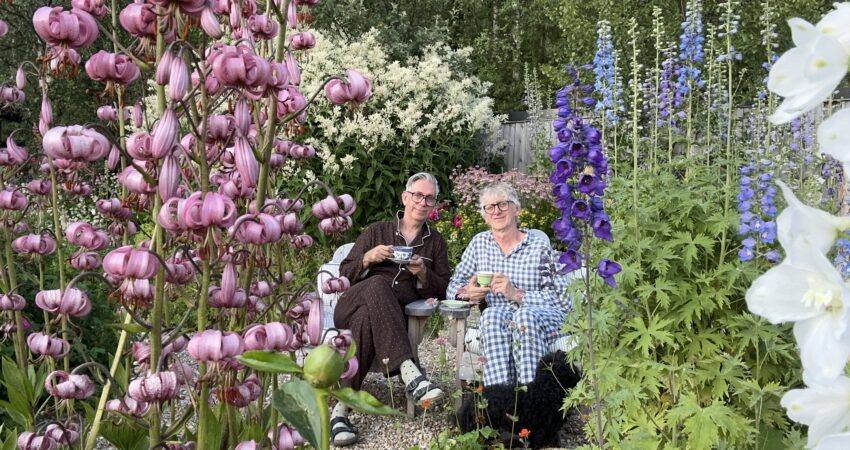
We were having breakfast in the garden this summer, surrounded by peonies and delphiniums and roses all blooming at once, and the bees were everywhere — so many of them, so constant, that they sounded like they had always been there.
They had not.
There were no bees here once, because there were no flowers for them to come for. There were no birds either. Something felt off when we first moved in, though neither of us could say exactly what.
We heard the story eventually — the previous station master had shot every bird that came near the place — and understood.
There were no birds. That was it.
We only won them back by feeding them, generously, probably too generously — seed, but also fat: coconut oil, scraps of ham fat from Christmas, whatever we had. More than one bullfinch grew round enough on it that we would watch him wobble to the feeder over morning coffee like a small barrel.
“I think we should take it down a notch, Arne,” I said one morning, watching a particularly heroic effort to reach the seed covered in coconut fat.
We built houses for them too, whole clusters, hoping enough of them would stay. Some did. Enough, now, that every year we watch a family move in, and every year, eventually, we watch them leave the nest — which still catches us both, every single time, probably because of how hard we once had to work just to get anyone to come at all.
Alexandra
We met her during those early years of building the garden, while we were in Paris for work — a woman with a small, secret garden, walled in high enough to feel hidden, extraordinary for the middle of a capital city.
The garden consisted mostly of gravel and pots; Arne resisted grass for years afterwards for no better reason than that hers had none. Every time we visited, we would find her in it, often just back from riding, and more than once she would show us the latest arrivals — whatever she had recently acquired, or whatever happened to be blooming — before she showed us anything else.
Like the olive tree that had clearly arrived only the day before.
“This is my new friend,” she said, meaning it completely.
It did not strike either of us as strange. We had been introducing delphiniums to houseguests the same way for years.
Her own gardener, a genius with plants where Alexandra was not, would appear from nowhere every time she reached for a flower, slap her hand gently away, and scold her in French. I understood every word. Arne, who speaks none of the language, understood just as well.
She and her garden left one of the deepest impressions either of us has ever had. They inspired an entire winter collection we designed and called Ladies in the Greenhouse. We gave her a wool coat from that collection afterwards, embroidered with flowers, for something she never knew she’d given us.
A Book Called Garden People
We had already met Alexandra by then, and something about her — the olive tree, the delphiniums, the whole secret garden of it — had told us she was one of us, in a way we did not yet have words for.
Not long after, we came across a book called Garden People, with Valerie Finnis’s photographs of English gardeners caught over the course of the twentieth century.
We returned to it obsessively, long before we ever set foot in England ourselves, looking at the same photographs over and over. We did not think of it as research. We simply loved looking at it.
It was the people, more than the gardens themselves, who held our attention.
There were, it turned out, many of us.
We had that same feeling on our first garden trip to England, years later, boarding a train because an Icelandic volcano had refused to let us fly: that we might meet a few more.
The National Trust’s Secret Weapon
Our very first stop was Sissinghurst, the most famous garden in England, and we arrived with the kind of anticipation that had taken ten years to build.
At the ticket office there was a woman sitting on a round table slightly apart from the counter, knitting, watching the queue the way a Miss Marple might — taking everything in before saying a word.
She set her knitting down as we approached, looked up, and said, “Hello, gentlemen. And where are you from?” — and invited us to sit with her.
We knew, before she had said another word, that whatever she was selling, we were going to buy.
We talked about her knitting first — baby blankets, for charity. Only once that conversation had run its course did she get to the actual business: might we be interested in a membership?
The cost worked out to roughly three entrance fees for the two of us, and after three properties, everything else was free for a year.
Look at the map, she said. Look at everywhere you could go!
We joined on the spot, and spent the rest of that trip driving around England with a National Trust badge proudly displayed on the windscreen of a rental car, discovering places neither of us had known existed until we saw them on her map.
We have kept the membership for years since, and we still greet every volunteer we meet with real enthusiasm — most of them still knitting, still answering questions, still having a jolly good conversation with whoever sits down next to them.
There is something about being Norwegian in an English garden that reliably leads the conversation to one of two places: the Vikings, or the war.
A Fiftieth Birthday, and a Room Full of Manure
For Arne’s fiftieth, I asked him what he would like to do — thinking, honestly, of something modest, a day in Lillehammer or Oslo.
He said Calke Abbey.
I had to look it up.
I booked a hotel in Gloucestershire, Lords of the Manor, which at the time had a very well-known restaurant. It was his fiftieth birthday, and I was not about to leave dinner to chance, so I wrote ahead to book a table.
We were told the restaurant was closed that evening for a private event.
What kind of event, I asked.
A talk by the garden writer and designer Bunny Guinness, for the locals.
Might we be allowed to join?
Yes — booked.
I may have misjudged the distances, because Calke Abbey, it turned out, was the better part of five hours away and back. We arrived at the hotel with barely enough time to change, sat down among a room of well-dressed strangers, mostly in tweed, and listened to Bunny give a genuinely captivating lecture.
Afterwards, we had a lovely conversation with her too. It turned out she had worked as an au pair in Norway in her youth, and still had fond memories of our country.
The rest of dinner turned to manure.
One woman set her handbag down on the table with real ceremony and announced, in a beautiful, posh accent, that she had a great deal to say on the subject.
She was not wrong.
It remains, we think, the finest fiftieth birthday either of us could have arranged, and neither of us planned a single hour of it.
Pyjama Gardeners
For twenty-seven years, we have run outside first thing, still in pyjamas. We never thought much about it; gardening that way simply felt natural. At some point, a photograph of one of us, or both, doing exactly that ended up on social media. One of our Instagram followers left a comment:
“Gardening in your pyjamas? There are many of us.”
Nowadays we really don’t mind being photographed in our pyjamas.
It helps that we own rather nice ones.
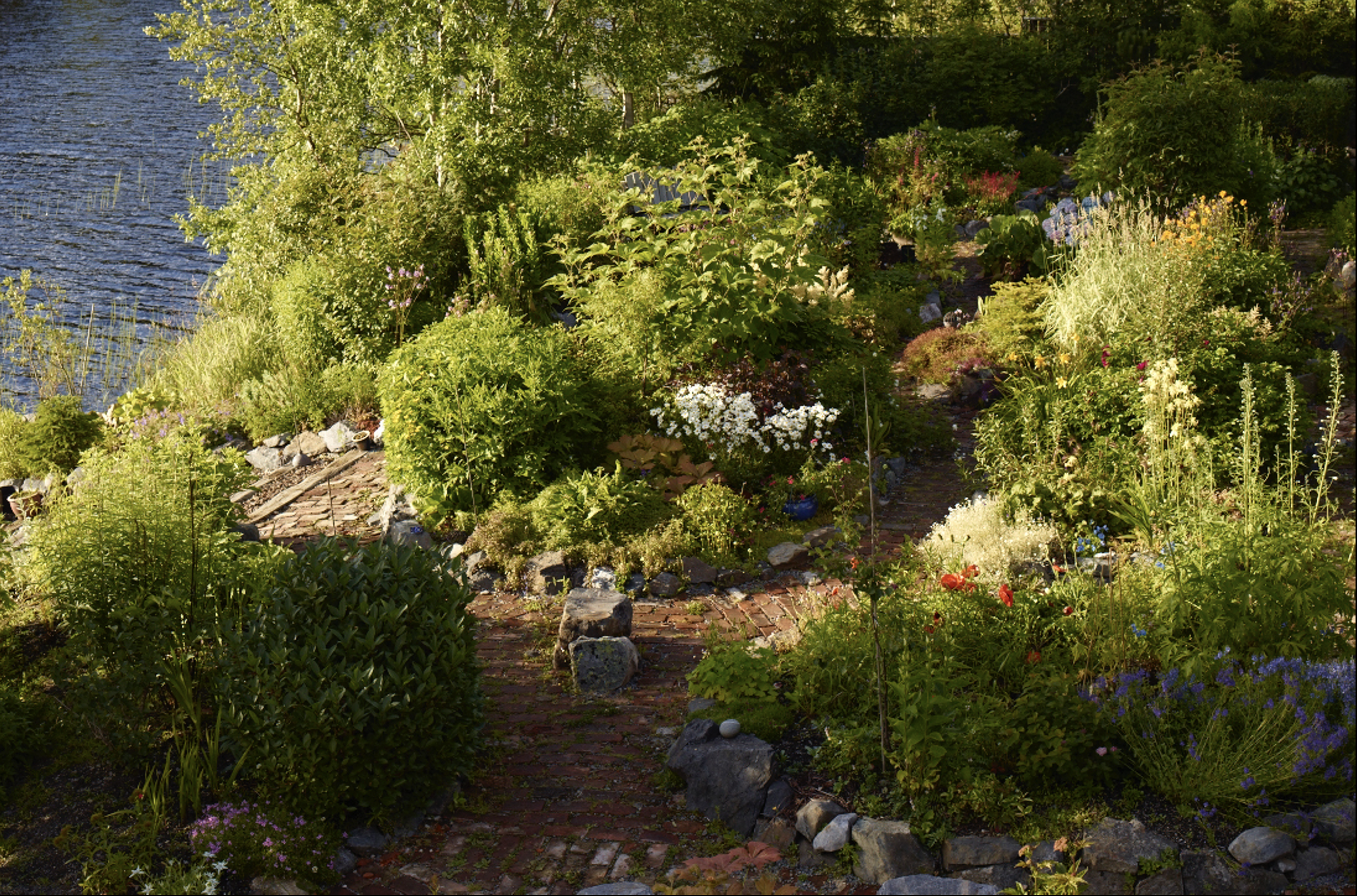
In 1999, Arne came home from a weekend away and told me, somewhere between the skiing and the knitting, that he had bought a train station. There was a grey platform, a lake beside it, and nothing else — no flowers, no birds, no bees, not the faintest idea of what any of this would become.
Twenty-seven years on, we no longer know where the garden ends and the rest of us begins.
It gave us birds, and we gave it houses. It gave us bees, and we gave it flowers to come for. It gave us Alexandra, and a book, and a volunteer with a map, and a woman with strong opinions about manure, and it has asked for nothing back except the one thing we still give it, every morning, before we are even properly dressed: our attention.
We did not set out to become this. We set out to start a design business.
We built a home instead, and the garden built us — designers still, artists still, but pyjama gardeners now too.
The platform is still there, somewhere, underneath all of it.
We have simply stopped being able to see it.
From our railway station in Norway, where the bees are, this week, too many to count.
ARNE & CARLOS
Skip to comment form
Another beautifully written story. You seem to be able to transport your readers back in time and recreate the atmosphere so vividly. What a wonderful 50th birthday too ! Sometimes things work out that way as if by magic. I believe the rapport you have with people you just meet is probably because you two are obviously very charming chaps !
incredibly well written and inspiring. Blessings to you. Barb
Dear Arne and Carlos,
You two are such an inspiration to me. You make the world a better place just by being in it.
My husband and I are in the beginning stages of creating a yarn store. We started early this year, but had some setbacks and now it’s near the end of the year and we are no further ahead, but we have not given up on our dream.
It would be lovely to be able to invite the two of you to our little town of Nakusp, British Colombia and show you our yarn store housed in an old church and landscaped with an English garden. That’s the dream. I hope we can make it happen before we all get too old.
Bless you, Arne and Carlos.
Dear Arne and Carlos, such a beautiful piece of writing.
However this is written on a very sad day, the wonderful King Harold had died only a few days after your beloved Dolly, Arne.
Two people who have left an indelible mark on all of our hearts.
May they both rest in peace.
Much love
Christina
from Adelaide
We’ve never met, but I feel we’re friends. You’re a soothing balm as you teach, knit, and share with sincerity, earnestness, and humor. I love “visiting” with you in all seasons, and look forward to your flowers, lovely projects and patterns, recipes, glimpses of Freya, and now I savor Parts 1-3 of The Garden That Shaped Us! I feel there’s so much more that has shaped you both (that I needn’t know). But, I do know how sweet and beautiful you are.
lovely to read about pyjama gardeners. I to garden in my PJs.
I can’t imagine never not being able to grow something. The first thing I ever planted and grew was a peanut as a child in Kenya were I lived until 6yrs old.
I also knit and crotchet simple things. I have however made some of your Christmas balls. The first time I knitted in the round. it worked!
I have recently got home from a hurtigruten cruise . maybe one day I will join you on one of your cruises and knit with you.
🥰
I sincerely hope that the joy you give all of us with your wonderfully written lyrical tales bring you the happiness and joy right back. I somehow can’t imagine that they don’t because you seem like such joyful loving spirits , like gentle garden sprits that dance among the flowers. Thank you from the very source of my being for the memories and life you share! Love to you both.
I enjoy these pieces of writing so much. You both write really well and I feel completely transported to the places and memories you are recalling. Thank you!
Very beautiful memories! I am very close to 82 and I appreciate those great memories even if they are not mine! Love from the midwest USA, Wisconsin.
Thank you for sharing your loves and life. Sweet. And much appreciated.
Thank you for sharing your beautiful memories. You write so well, they make me feel as though I’m right there with you! <3
Thank you Arne and Carlos for this loving walk down memory lane. I so enjoyed it all, the hard work you two put into the home and garden, houses for birds and food for the bees. I love every part of you two and the artistic ability you have and the wonderful loving personalities.
Thank you Arne and Carlos for sharing these garden stories. I always love to see the pictures and videos. The canoe ride was the best!.Love you guys!
This conclusion to your garden evolution is pure poetry, tying childhood memories, years of toiling over stones and soil, and your sumptuous results together perfectly. I am in awe at your accomplishment- the garden is so lush and varied that no one would guess its own secret – that it is planted on an unforgiving bed of concrete! In my own little garden, each summer morning I savour watching the bumblebee and hummingbird searches for scarlet runner bean nectar, the late comers resorting to morning glory searches. And I am always in my housecoat as pyjamas aren’t used…
Thank you so very much for sharing your marvellous world and memories with us. Yours is the ONLY blog I follow!
This conclusion to your garden evolution is pure poetry, tying childhood memories, years of toiling over stones and soil, and your sumptuous results together perfectly. I am in awe at your accomplishment- the garden is so lush and varied that no one would guess its own secret – that it is planted on an unforgiving bed of concrete! In my own little garden, each summer morning I savour watching the bumblebee and hummingbird searches for scarlet runner bean nectar, the late comers resorting to morning glory searches. And I am always in my housecoat as pyjamas aren’t used…
Thank you so very much for sharing your marvellous world and memories with us. Yours is the ONLY blog I follow!
So enjoyed my morning with my cuppa, reading this, being transported in my mind to your garden. Thank you.
In the crazy world I live in your stories are wonderful.
They make me slow down, read and smile.
I look forward to them and awaiting your new T – Shirt pattern.
Thank you for sharing.
Thank you so much for writing about your garden over these three essays. I have enjoyed every word; you have made me laugh and cry. I love you guys so much. Take good care of each other. Love Annie xx
Such a lovely essay and I thank you both for the moment of peace I experienced as I read your calming words.
Thank you for a wonderful, heartwarming account of this treasured part of your lives. You both write very well – a pleasure to read! I joined recently for knitting tips and ideas and already received so much more! Best wishes from southern New Zealand!
Thank you both for sharing your lovely stories!
I am the worlds worst gardener, but, I’ve kept at trying to build one on every continent I have lived on. Even this failed gardener loves gardens and admires those who get it right. I’m in my 80’s now and still trying. But I have made lots of friends amongst the birds who visit. The Sea Eagles call down to me on their way to the hunt. The magpies join me on the patio at lunch time and all the little birds drink and wash in my bird baths. Even not so good gardens have their beauty.
Lovely story, thank you for sharing
I am wondering if Arne remembers where in Wisconsin Tobias lived? I am from the southeastern corner 35 miles from Lake Michigan
💙
I have loved all of your posts. And this garden saga was just the best. Please keep sharing your stories with us, your devoted readers and knitters.
I have been so moved by this story of your journey with the garden. You are two very special people who have shared this story with us quite eloquently.
Thank you so much, this has been an amazing gardening journey you have taken us on! I’ve been an ardent gardener since my teens and feel best smelling dirt and chlorophyll. Your writing is lovely and it’s been a joy to read. I hope you will continue to share your stories!
OMG. I have LOVED reading this garden story. Please Consider turning this into a book.
I watch with great anticipation for your next Quiet Threads. You both have a way with words. I am blessed for having found your YouTube videos, Christmas projects, blogs… not to mention traveling and thoroughly enjoying your company. Thank you for just being you and sharing your experiences. xoxo – Cynthia
I love how one thing leads to another with out meaning to. You both write beautifully and I enjoy these stories of your journey. Thank you and please let there be many more.
Dear Ones!
I’m not much of a gardener, as my sweet hubby of 54 years loves to take care of that, but I contribute with an annual visit to our favorite rural nursery with my dear sister Lisa. We wander from greenhouse to greenhouse, collecting a few ornamentals and lots of vegetable starts. I lean into her expertise; our gardens are in very different zones. Mine in a valley formerly filled with apple orchards, hers on a mountain where deer & moose visit. I do manage our front & back patio pots, and this week was blessed with sighting two tiny baby bunnies, dropped for a bit in one of the pots by their mum. Gone in the morning, hopefully picked up by said Mum. Sweet pea flowers are a nostalgic favorite. My bridal bouquet was a gathering from a field near the chapel where we married on the campus of the University of Idaho, crafted by a dear girlfriend and my sweet groom. Wild sweet peas, morning glory to trail down, that I carried to the altar wearing my handmade white eyelet gown.
Thank you for sharing so much of your stories. It helps me imagine the lives my Swedish grandparents lived, and also my stepdad’s Norwegian parents, back in the old countries. Oh, and my Swedish gramma Amanda taught me to knit when I was 10 on her last trip to visit with us. I was given her knitting needles, and still remember what she was making on that trip. Her father, a fisherman, taught her to knit. I taught my dear daughter Maja after she finished graduate school (Japanese!), and she has far surpassed me in her creations. Lots of colorwork yokes, beautiful cables, lovely lace. I’ve taught my nieces to knit, and hope to teach their kids to knit so that line continues.
❤️
Just wonderful. Thank you. I love gardeners. You two are special beings. ev
Thank you for this series, but especially for this post: it is a love letter to a life well-love and yet to be lived, we hope, for many years to come. Here is to art and craft and yarn and a scent that wafts to you at twenty paces away, a breeze off the water, greenhouses that may not be in the ideal spot for being a greenhouse but in a perfect place for them to be. Thank you.
Carlos and Arne you are both such eloquent writers. Thank you for the quiet moment to share in your memories. I too, have childhood memories of gardens and greenhouses, that I know shaped who I am. My garden is nothing like your lovely “train platform “ but every morning I find a bit of joy and peace as I water, pull weeds, or cut flowers for friends. Thank you so much for sharing. Tricia and I are so excited to be joining you in South Africa in January. Take Care.
Kathy and Tricia
Thank you for sharing your interesting and beautiful memories. Having lived in apartments for most of my life, it is a sheer joy to try and visualise your gardening journey and the obvious pleasure it’s given you both. Nothing beats nature’s beauty.
Wishing you many more year’s of happy gardening.
Dear Arne and Carlos,
As usual, a truly delightful read.
Thank you!
Paige
I’m really not a gardener, but this story brought tears to my eyes. Love you guys!
Gardens are truly marvels of nature. When I was growing up, we always had two gardens-a vegetable garden and flower garden. My father planted a pussywillow tree outside his and my mother’s bedroom window. There came a year at our house on East Central Avenue and Hilda Street when my mother wanted more lawn in the backyard. So my father did not replant the vegetable garden the following year, but reseeded it instead. That summer, and succeeding summers, the asparagus came up as usual. There were those slim stalks sticking out of the green grass. Sometimes a garden knows better than we do what we need, and proceeds to provide it for us. Enjoy your garden in your pajamas, Arne and Carlos.
Our past always reflects our present. Isn’t it wonderful to know we are always planted exactly where we are meant to be? And that is where we grow into who we truly are. Together…that is the word that connects it all. Thank you for the many years you have share with me. Your strength and commitment have guided me through many of life’s trials. You two are the best!
Your garden–WOW! My mom and dad were excellent gardeners. In south St. Louis, Missouri, USA, my dad planted over a dozen rose bushes, which flourished. Mom planted dozens of daisy plants. Our small lawn in front of the house was like velvet.
I have trouble keeping plants alive. I went to our local nursery and asked for plants that thrive on neglect. I am careful to water the plants when it doesn’t rain. So far, I’ve kept a few plants alive the whole summer. Yay me. 😉
I love you guys.
FranM
I really feel the love in your story and while I don’t give as much daily attention to my garden, the joy is just at strong. It is really almost beyond belief the beauty you have created from that platform!
It occurs to me a photo story book for children or the naturalists among us would be a lovely, story and inspiration for others.
bless you both!
Nancy
‘The rest of dinner turned to manure’.
That sentence had me roaring with laughter, Carlos. So sweet of you to give Arne that birthday present. Those birthdays are the best. Making memories together. And being in your garden in pyjamas, the best gardeners do so. My memory is a weird one; I remember from when I was a baby. Sitting on my mom’s arm, visiting my father in the pub he lived above, the wisteria winding around the roof with long blue flower vines. At 4 months old, I fell in love with Wisteria. My grandparents lived on the grounds of the paper factory, and the garden was around the house. There was a pond with fish. I was only allowed around the pond when holding his hand. I have had fish ponds and Wisteria on all the continents I have lived on.
merci beaucoup pour ce beau message sur vos jardins. J’en ai un petit qui a plein de fleurs malgré le temps très sec . je tricote aussi et entre deux rangs je me lève pour enlever des fleurs fanées. c’est un vrai bonheur d’entendre les oiseaux au petit matin en prenant le petit déjeuner. prenez soin de vous. Annie
such beautiful memories. Both of my grandma’s had kitchen gardens and one of my grandfathers used to cross breed orchids. His orchids were beautiful. I wish I had a picture of one of his orchids. I do have a Drecina, that is probably a fourth or fifth generation from the plant he gave my parents when they moved into their first home. I named the plant Sven, because house plants need names! Living in an apartment does not allow for a garden, but we do have a lot of plants.
I thoroughly enjoy seeing your gardens. Thank you so much for sharing.
I often remember my father’s gardens, flowers and vegetables. They were huge and he taught me so much about gardening. Now that I’m elderly and we live in a high rise apartment building, a few plants on the balcony for 3 short months in northwestern Ontario are all we can manage but oh how I remember the smell of my Dad’s flag irises and roses and chrysanthemums. Store bought flowers don’t smell anymore and I miss that the most.
Reading about and seeing clips of your garden brings me peace and joy. Thank you for the therapy you provide.
You inspired another trip down memory lane for me. From the flowers and trees in my childhood home in the Midwest, to my grandmother’s profusion of blooms to remind her of childhood in Hungary, each blossom populates the gardens in my heart. Even now there is a geranium on my tiny patio that started from a stolen pinch on a walk with my grandmother in 1974.
I love reading about your lives in Norway and also watching your Sit and Knit a Bit podcasts. They add a lot of joy to my days. When it comes to gardening, it is an effort for me. I hate wearing gloves, but also hate getting my hands dirty. Yuck! I did have a landscaper come in and do my back yard and in the front, I did, myself, do a lined wall around my sidewalk, front bed and a circle in the center of my yard. My neighbors love what I’ve done in the front and had done in the back – guess that should be enough to encourage me, right? Wish you could give me an answer on how to get the push and desire to become a somewhat good gardener. Last year I had a beautiful strawberry bed and what a wonderful crop. This year they all died and now I have nothing. What happened, I have no idea, but I will try to buy more plants next year and try again! I even bought special ground and planting ground with minerals in and they still didn’t live. But, I will persevere!
I would love to see more cooking segments too! Oh my gosh, you guys have me rolling on the floor with laughter sometimes! Wish I could do one of your knitting cruises, but that can’t even make my bucket list, but I will live through your podcasts that you share your travels in! Continue to enjoy your travels, knits, and cooking, and mostly each other! Love you guys!
Bless you both for opening magic windows to see into your lives and your histories. You have warmed my heart and started my day with joyful tears in appreciation of how you’ve both looked back with fondness at many memories.
I am grateful to you both not only for the creative inspiration, but also for how to approach each day with wonder. That’s the best lesson you can share and a great legacy to give the world during such difficult times.
Golly! These stories make my day. They inspire me to give my gardens attention, to pick up my knitting to “sit and knit for a bit”, and to locate my favorite picture books and appreciate the authors. Than you, Arne and Carlos.
Wow so interesting to read how all things garden fell into your lives from many encounters.
My first memories of a garden go back to my father’s garden, playing dolls in the grass next to the bed of lily-of-the-valley’s breathing in their exotic fragrance. Cutting red roses off the
White trellis entry to our yard. Eating apples and peaches off our trees and cutting German iris for the dear nuns at our school. Heaven.
Thank you for this, Carlos. I used to commute to work in Chicago. Instead of reading the papers, I would read garden books or seed catalogs that were mailed in winter to inspire spring planting. I learned a great deal about flowers and vegetables that way, but experience is the best teacher.
The story of the two of you and your beautiful garden has me in tears. My late husband and I moved to a farm that had belonged to his grandparents. They had managed to remove most of the trees from the 160 acres of farmland. This meant, to our dismay, that the wind blew from miles away and created a wind tunnel around our home. We planted more than 1000 trees, all by hand; from a former pig pen we created a very productive (quite massive) garden with vegetables, herbs, fruit, and huge sunflowers that grew over 10 feet tall. My late husband became a beekeeper and the bee hives lived on the grass border of the garden. It was heavenly.
I hadn’t considered myself a dedicated gardener until we moved to the farm. Prior to moving, I always had a small vegetable garden, but the farm inspired my husband and I to branch out to bigger gardening projects.
Sadly, my husband passed away in late 2022 and I found that I, as a woman in her mid 70’s, could not manage the farm on my own. I sold the farm and I now live in the city where my son and his family live. I miss the farm: the birds, the trees, the wildlife that would wander in for a visit. Wonderful memories.
Thank you for sharing your gardening journey with us.
I so enjoy your life stories…quite an adventure you have had…you have touched so many people’s hearts in your journey and I want to say thank you…Bless you both…
I so enjoy your life stories…quite an adventure you have had…you have touched so many people’s hearts in your journey and I want to day thank you…Bless you both…
Just as Arne thought he found Eden, I too, upon seeing your garden should think I’ve found Paradise.
Thank you for sharing beautiful memories and the life they have loving built.
Such a wonderful story about your garden. I always look forward to the next installment . Carlos- your writing is a gift to all of us.
Your gentle writings are so inspiring! I’m absolutely amazed at what you did with that gray platform: tons of work along with many miracles. It renews my enthusiasm for my own gardens which has been languishing. Anything you write about I will happily read.
Beautiful story I love nature too. We need more in America so much unnecessary noise here. Stupid garden equipment so loud leaf blowers never heard of something so dumb! When I grew up with my mom and sister we had a Japanese Gardener who took care of our yards front and back he was so quiet. Didn’t use heavy loud equipment we had many beautiful flowers and tress, he built us a sand garden too so we could meditate. He taught me to meditate and sit quietly and listen no think just listen.
Peace back then… We did have some grassy areas to play games on but he would use a quiet mower that wasn’t electric it was an old fashioned one. Blabbing I do that a lot your story just made me remember.. Have your written any books? I know knitting books I do have those and love them it’s getting hard for me to knit now but I still do. Hurt my spine years ago. Books about your lives would be fun to read as your storey was very nice. . Thank you for this and happy days and wishes.
Karen
Reading this draws so memories of my father’s gardens and the ones I have built over the years. Mother Nature is my best friend. Thank you for sharing this. It has made my day and will give me much to think about. All the best, Liz….who’s Grandmother came from Norway and had beautiful gardens in WI.
Thank you for sharing the “gentle threads”. They truly are a welcome respite from the chaos of the rest of the world. You’ve inspired me to focus more on my own “garden of Eden” in my own backyard.
thank you for sharing! wandering in early morning in pajamas is perfect!!
Such a beautiful story. I thank you very much for sharing this heartfelt tale. You are both fortunate and blessed. What a lovely life❤️
Take good care of each other,
Karen