

The Quiet Thread
Issue No.15 – The Bug.
Stories from our home at 682.5 metres above sea level
Written by Arne
My mother worked as a Husmorvikar, a profession that no longer exists. She worked all over Gausdal, the district in Norway where I grew up, a huge municipality, and if I remember right there were two Husmorvikarer who split the assignments between them. In the early days my mother rode a moped to work — it must have been rough in winter, starting out early in the morning on badly ploughed roads and in all kinds of weather. I remember she started early and got some work done at home first; we often woke up to the smell of freshly baked bread and the sound of cutlery clattering in the sink in the kitchen. She would probably rather have stayed home, but there were many adults on the farm, so she didn’t need to worry about us — we had great-grandparents and grandparents. So my mother could go to work, because we were never alone, with great-grandmother and grandmother in the house.
We called my mother Humlen (the Bumblebee), for she was always in motion — the moment she sat down, she fell asleep.
Most people today probably have no idea what a Husmorvikar was. So here’s an explanation. Husmorvikar (roughly, “housewife substitute”) was a new profession starting in 1955. When housewives ended up in hospital for one reason or another, the Husmorvikar stepped in and took care of house and children while the mother was at the hospital and the father was at work. That’s how my mother became a stand-in mother for many children in the district, both in Vestre and Østre Gausdal. The Husmorvikar was trained by the municipality and the service was subsidised by the council, so families only paid a small fee — and for some, once that added up, it was free.
The Husmorvikar was more a social worker than a housemaid — they had to study things like practical psychology, civics, sickroom care and diet food, home economics, work efficiency, and infant care through theoretical training. And they required a fair amount of practical experience before they could even take the course. Housecleaning wasn’t part of the job, but mending clothes and cooking were common.
My mother started the five-month course for Husmorvikarer on 30 July 1957 and finished on 19 December. During that time she did practical training at the Central Hospital in Kristiansand, in the south of Norway, the Nursing Home in Kristiansand, the Red Cross clinic for mother and child, looked in on children’s homes and day homes, and finally spent one week at Søgne Agricultural School. She worked there for a while, before she and my father got married and she got the job in Gausdal municipality.
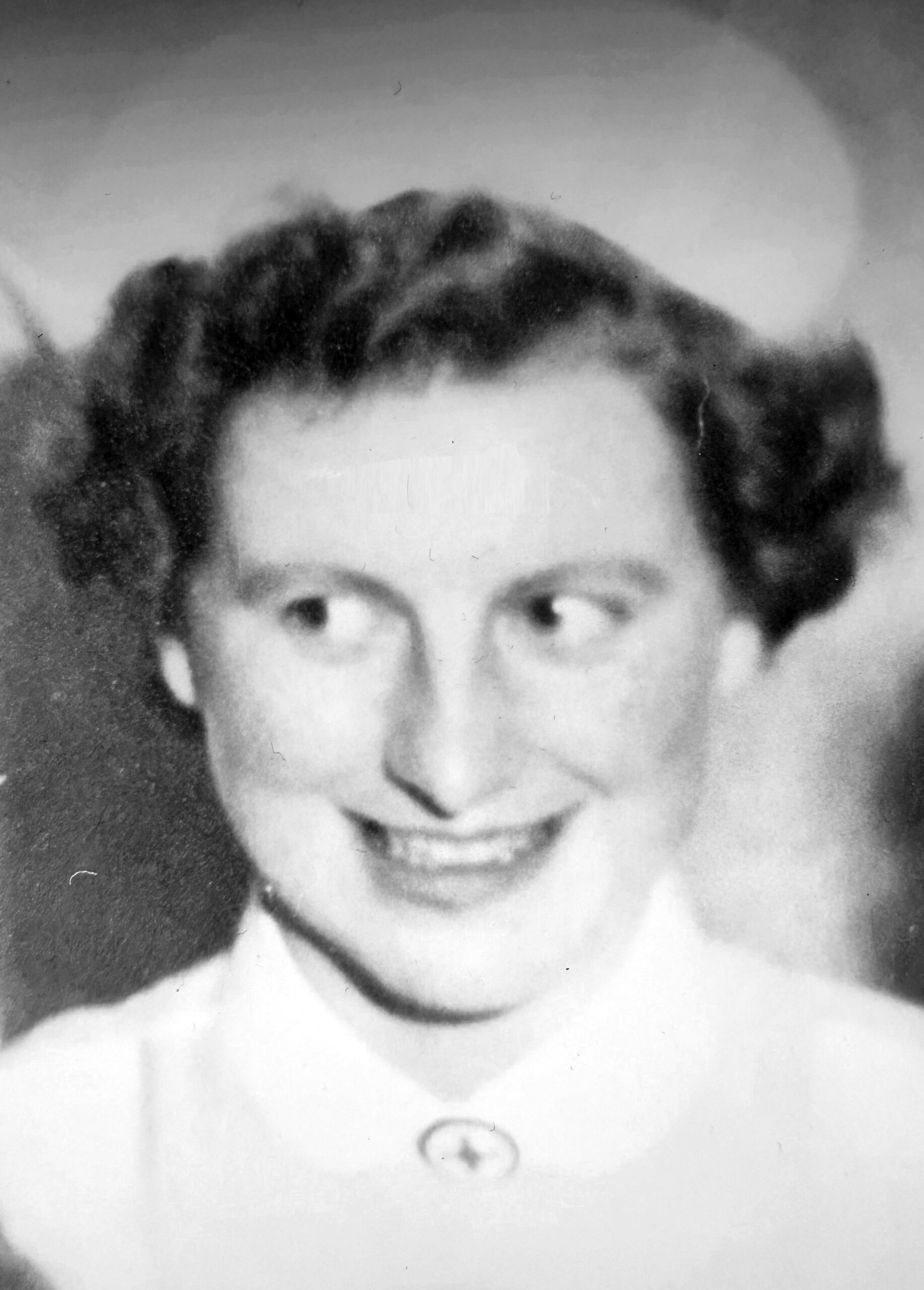
My mother in 1956.
Eventually she got her driver’s licence and life got a bit easier — though she still had to bundle herself up and always ended up looking like the Michelin Man, since the Beetle is famously a car with two winter temperatures: cold, and colder. But she was shielded from snow and wind, and the Beetle got through in all kinds of weather. Sometimes she drove with a sack of flour in the back seat so the car would be heavier and handle the slippery uphill stretches better. The driveway at home could get icy in winter, and then my father would walk out to meet her as she came home from work, standing on the back bumper and holding on to the roof rack.
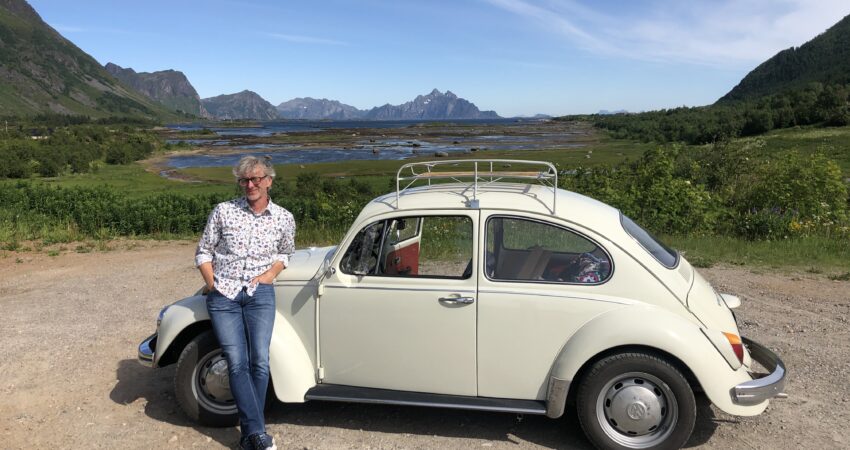
My Bug was my mother’s third VW Beetle, a 1968 model bought secondhand in 1984, and this one had a bit of luxury to it — she had a petrol heater installed, so it gave off some warmth in winter. But you still had to keep one hand on the wheel while the other scraped ice. So today she’s a summer car — you can’t drive around with ice on the windows any more, a little peephole to see through doesn’t cut it now, you’d lose your licence for that.
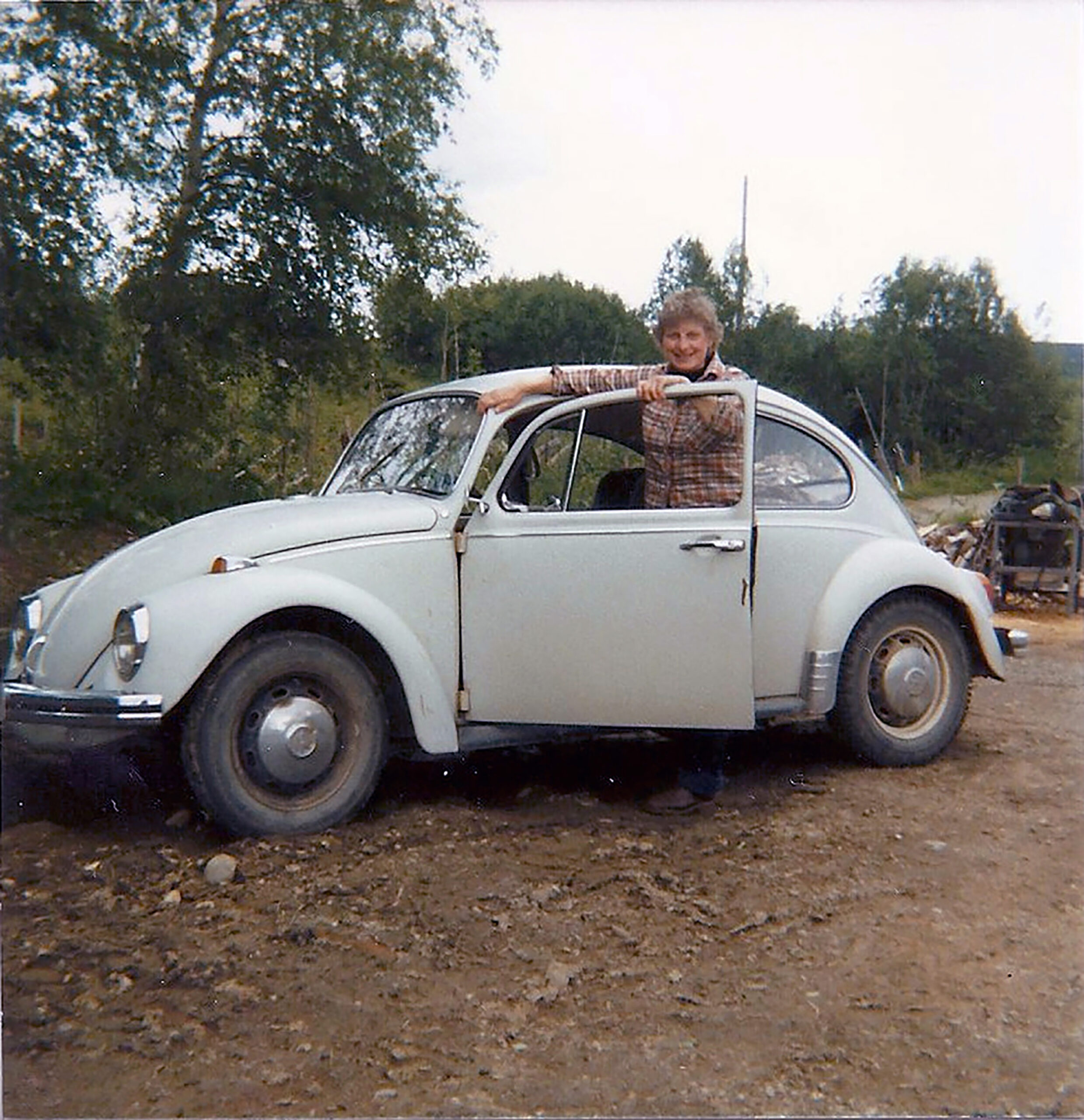
Proud owner of a “new” VW Beetle 1300.
When my mother later, in the ’80s, bought a modern car, she gave me the Bug. I got my driver’s licence in 1986 and also had a VW van for a while, but it didn’t last — the exhaust came in through the heater and the car was scrapped. After that it was just the Bug. But there was never any trouble with her — all you needed to know was how to top up oil and petrol, and how to change the fan belt. It was wise to keep some spare fuses in the glovebox in case something stopped working — then you just fitted a new fuse.
I worked as a dairymaid at our sæter (outfarm) at Mjødokka in Gausdal Vestfjell, with Langsua National Park all around us. The area was protected in 2011. One summer I drove milk down from our sæter to the dairy. I had a tow bar and a small trailer and made the trip every other day. Quite a sight, lining up between the big milk lorries to get my churns emptied. This was before mobile phones were common, so if I needed the vet I had to jump in the Bug and drive about half an hour to the café to ring for help.
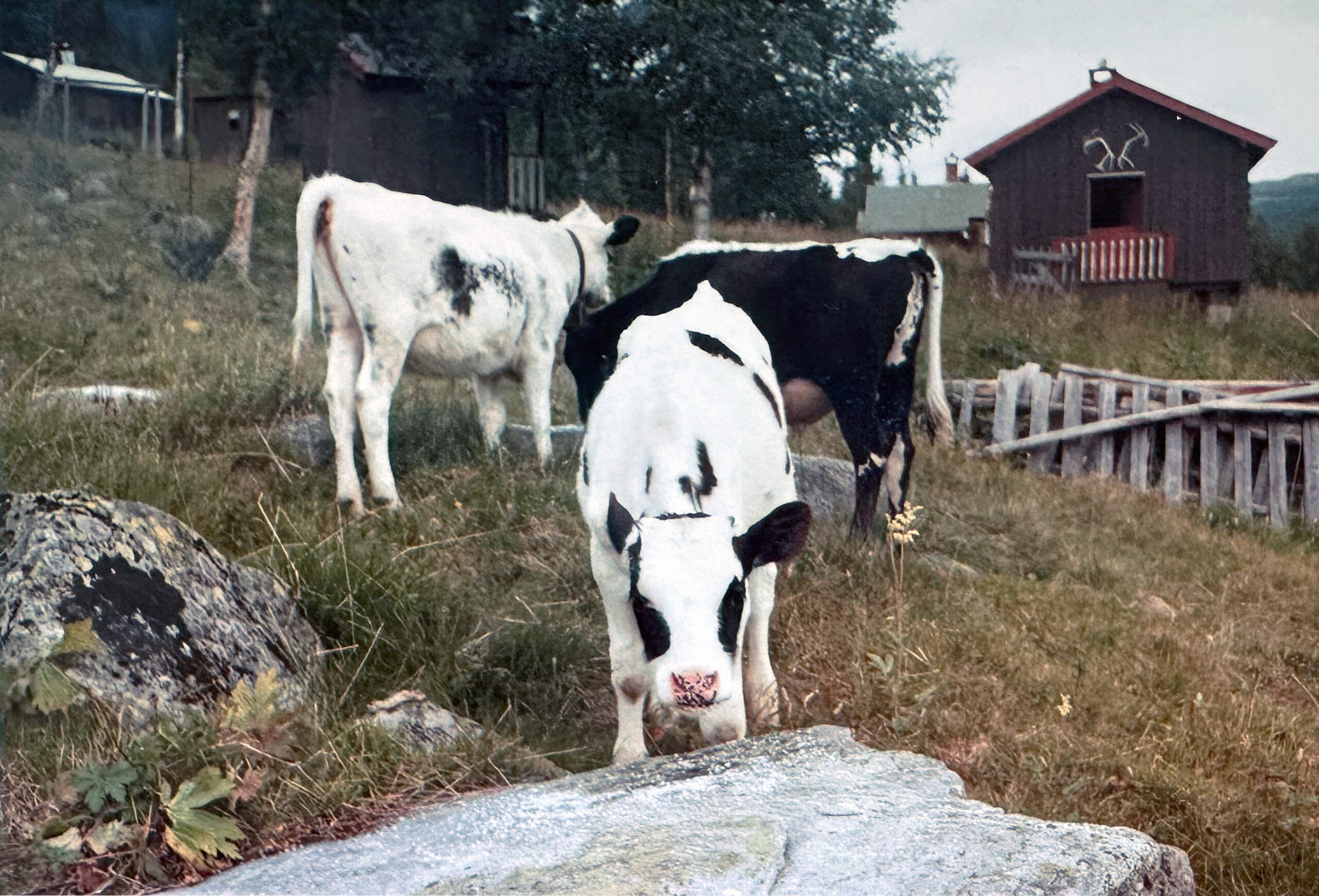
Fjellros, Stule and Fagmann. Fjellros on the left, grew up to be the lead cow with the bell — a very home-loving, gentle cow.
Once the neighbour who had a cabin at our sæter fell ill, I drove to the café again to ring the doctor. They wanted to send an ambulance, and I had to wait by the café until it arrived, since they didn’t know the road. There was only one road, but I didn’t try to explain, so once they got there things got hectic — there was, after all, a sick woman waiting up at the sæter. The road is narrow and winding, but I know it like the back of my hand. What you had to watch for especially was moose — I knew where the cows were. I led the ambulance up to the sæter, and the Bug could go faster than they could keep up with; on the long straight stretches I’d get well ahead of them, so I had to slow down and wait until I saw them behind me again before setting off once more.
We arrived and the woman was taken to hospital; after a few days she was back, good as new.

Coffee break on a mountain hike with grandmother and my mother in 1986.
Then I moved to Oslo to study, and there was no need for a car any more, so to save money I took the plates off and she ended up in a field down in the woods on our farm back home in Gausdal. She stood there for a good four years and was more or less forgotten. Until one day I went to look for her, and there she was — a bit spotty from all the leaves that had landed on her over the years, and the tyres flat. My father said kids had been playing in the car, the windscreen was cracked, and the front seats had been picked at and weren’t in good shape either. So I had the saplings around the car cleared, pumped up the tyres, put in a new battery, and she started on the third try. I drove her up to the farm and gave her a proper wash, and saw there was still something to work with here.
Later we moved her over to our home in Valdres with big plans, but it took time. She got new glass in the front window and eventually a new engine — one from the next year’s model, a bit stronger than the one she came with. Only after thirteen more years under a tarp did we finally afford to fix her up properly. Luckily there’s a lot available for a VW Beetle, and parts were ordered from both Norway and England. Parts weren’t all that expensive either — it turned out cheaper, for instance, to buy new floor panels and screw them in than to weld the holes in the floor, and it looked better too. She was repainted and got new interior trim, new seats from a used shop, and new seat covers from England.
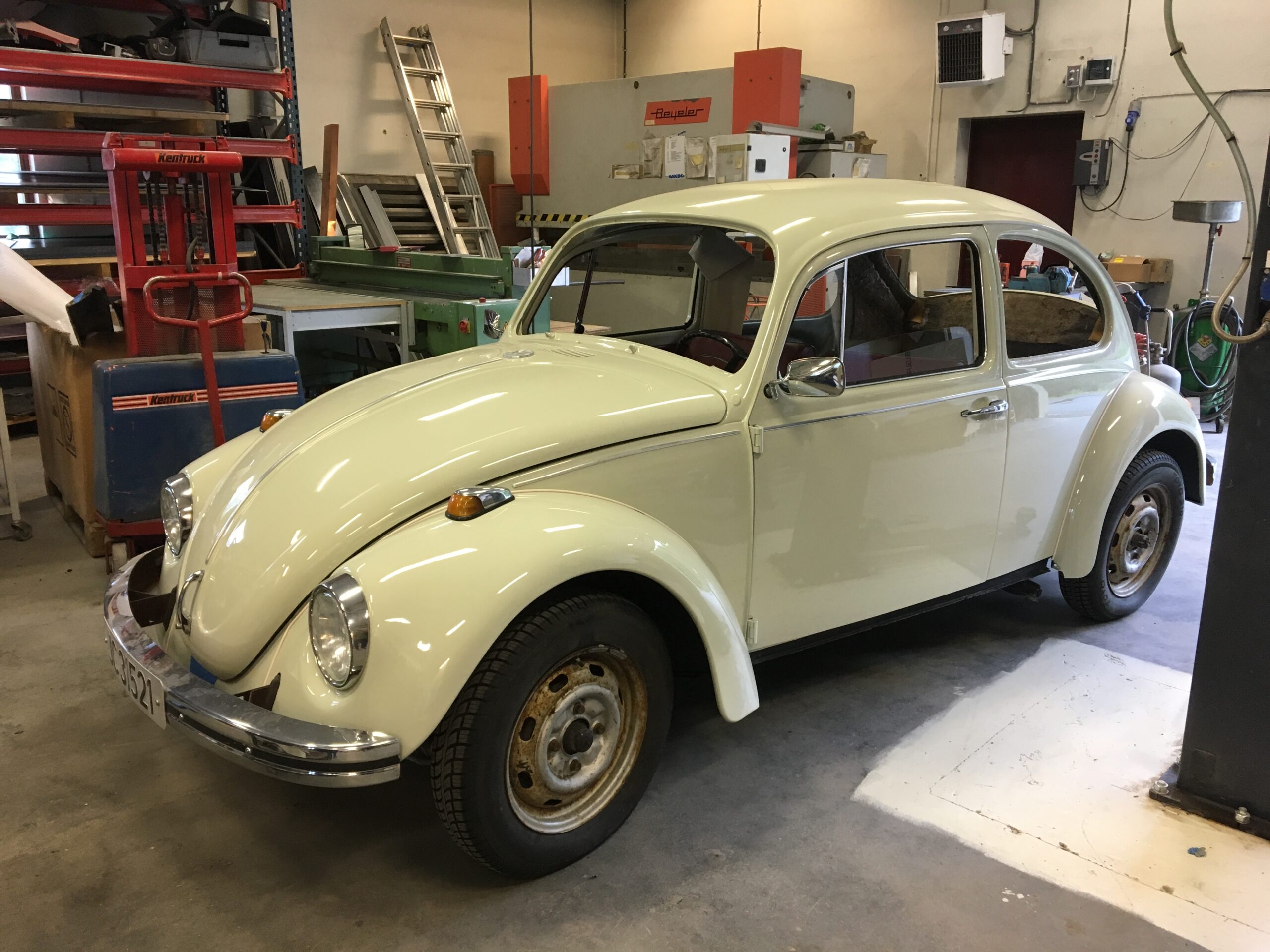
The Bug freshly painted, and us a few thousand kroner poorer.
As I said, the Bug is now a summer car. After the renovation, we couldn’t leave her under a tarp in winter any longer, so we finally built her a garage.
We’ve had many lovely trips around Norway, and one long journey to Skåne in Sweden. The longest of them went to Lofoten in 2020, where we met our YouTube team and filmed some episodes. That summer we were all being encouraged to holiday in Norway because of covid. We drove the E6 to Steinkjer and then took Route 17 further up to Bodø. You have to take a few ferries on that route, and we were lucky — we heard from other travellers that the big rush of traffic came right behind us, and there could have been ferry queues all along the coast. But the Bug is a small car, and most of the time we got waved on when a ferry looked completely full — we didn’t take up much room compared to the modern cars. That summer, other travellers were waiting two to three hours for a ferry, with the whole country holidaying at home because of covid — but thanks to the Bug, we made it all the way to Lofoten without ever having to wait for one.
Many people have memories tied to the Beetle, and when we drive around in the Bug we always end up in conversation with someone, wherever we park. So this really isn’t a car for the shy — you have to be sociable in this one, and sometimes Carlos struggles with that, since he’s actually the shy one. I grew up in the countryside, so I have no problem with small talk. We’ve often been told by people of my generation that it was their first car, and you always get a story about it. It was, for instance, astonishing how many people you could pack into a Beetle, and many remember that as children you’d sit at least two in the hole behind the back seat, where a hat shelf was supposed to be.
We had a few overnight stays on the way up the coast to Lofoten, since you don’t want to rush a journey like that — you have to take your time, enjoy the view, and stay at some of the lovely hotels along the route. We took the ferry out to the island of Vega, and there the Bug turned stubborn as we tried to set off again the next morning. We weren’t allowed to drive over 40 km/h on the island, and she didn’t like that, so she hopped like a rabbit, and we had to give it full throttle in second gear to keep her from stalling. We got back on the ferry to the mainland and rang a garage — can’t remember where — who told us what they thought we needed. But once we were back on the mainland and could drive at 80 km/h in fourth gear, she came right again — just as we’d suspected, she hadn’t liked crawling along at 40. By the time we reached the garage she was perfectly fine, and they told us that the part they’d assumed she needed couldn’t be got hold of on such short notice. They were rather impressed by how far we’d already come, and by how much further we still had to go. The Bug got told how lovely she was, and we were proud!
Afterwards we were tourists again and looked at Saltstraumen and had prawn sandwiches in Bodø before taking the ferry over to Reine in Lofoten.
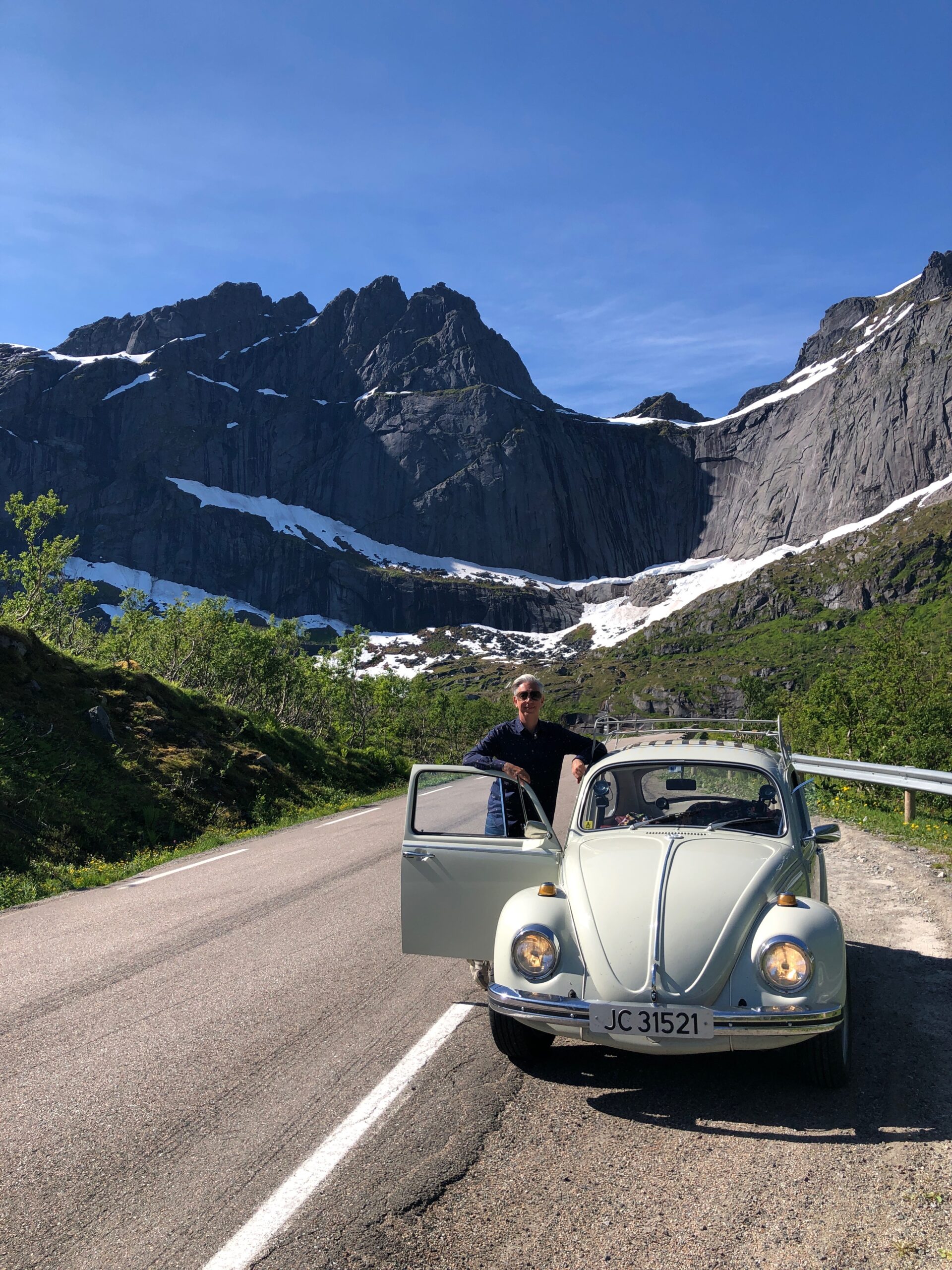
From Reine in Lofoten.
We’ve travelled quite a bit around Norway with a lovely group of ladies and their fine cars. On those trips we often stay at the old historic hotels, and when the row of old cars parks in front of such grand buildings, it feels a little special — they seem to belong in surroundings like that.
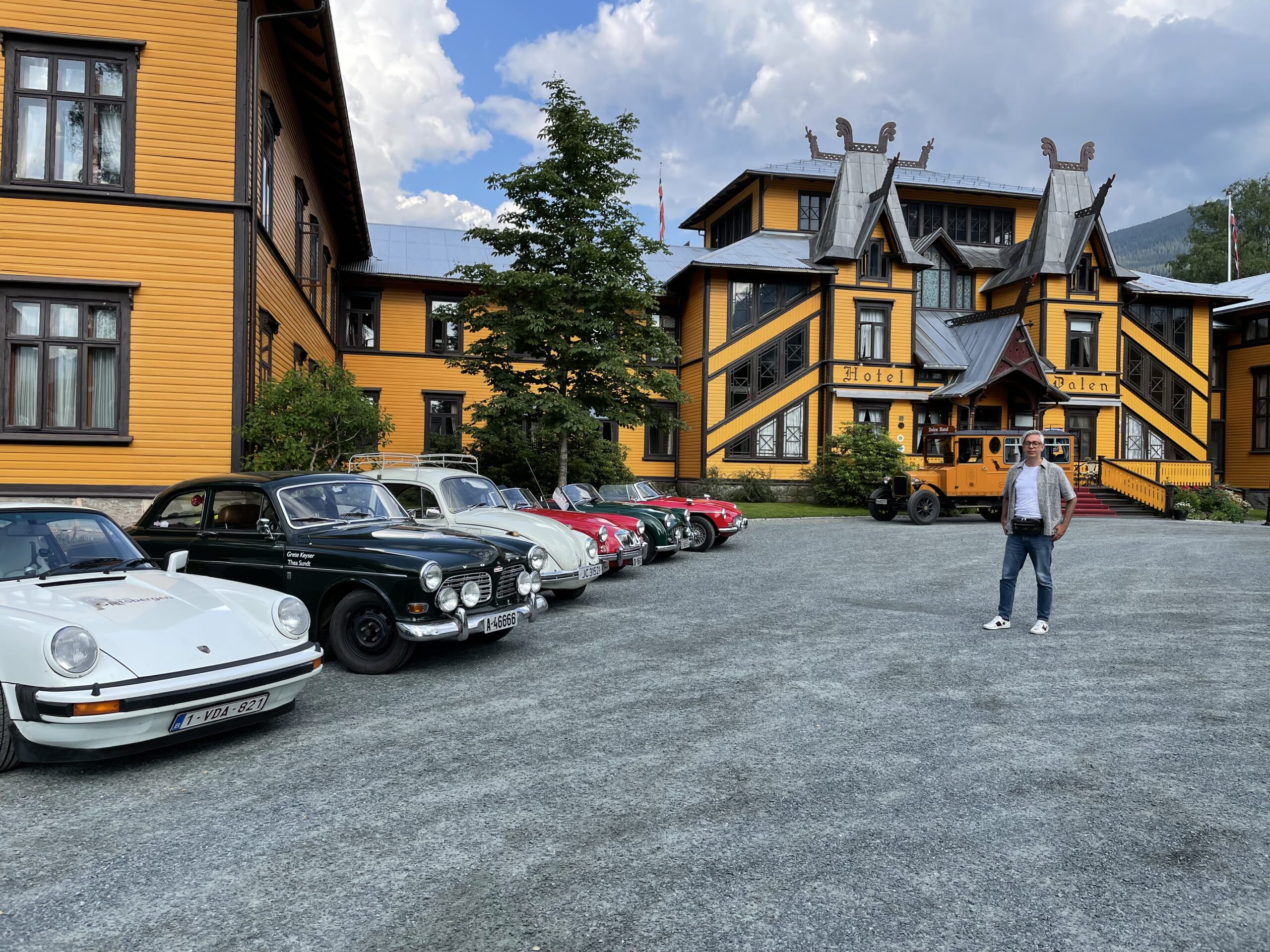
Here we’ve arrived at Dalen Hotel in Telemark.
Many of the other cars in our group are MGs and Triumphs from the ’50s and ’60s, all water-cooled, and on a warm day climbing a mountain pass they sometimes struggle and have to pull over to cool down. The Bug is air-cooled and never has that problem — so we get to trundle steadily past them, sporty convertibles pulled over at the roadside, while she just keeps going.
My mother said, in her later years, that there was one thing she regretted, and that was all the time she didn’t get to spend with us children, and that she had to make up for it now that we were grown and she was retired. She wanted as much time with us as possible, and to make up some of the time she’d lost with grandchildren, and eventually great-grandchildren, too. I was grateful for the time we did get with my mother, though it wasn’t as much as I’d wished, because by then I had become like her — always on the move, just with longer trips. That’s maybe part of why it became especially important to me to get the Bug running and back on the road. I wish my mother could have come along on drives in her — she would have loved that. Now we take the trips, and do the things she never got the chance to, and it’s become a few fine drives in the old Bug, with my mother along in spirit. We’ve also given her the name Humlen — after my mother.
Skip to comment form
Obviously, your mom was a special lady. Thanks for sharing this wonderful story!
What a lovely story.
I still have my first car, a light blue 1969 VW Beetle, named Hobbit. I bought him in 1974, only the 2nd owner. I have to double clutch in and out of 2nd gear, due to damage by the first owner. Hobbit has taken me into the mountains and deserts and even into the deep snows of back country (we almost got snowed in that time!) He was wonderful to drive to the ski mountain, where other cars had problems with the deep, deep mush of snow and dirt and water. I love my little car and will never part with him. He currently has place of honor in the garage, as I drive a Subaru now, with heat and Air conditioning as needed. But we get him out for drives every Spring and Fall. Happy driving! (I am in Idaho, USA)
I LOVED this story and hearing about your amazing mom! You two look so much alike. My favorite Beetle memory is bringing home my beautifully handmade and very large 4-harness table loom in the back of my best friend’s VW while we were design students in college. I can’t believe we got it into and out of that space! I still have that loom. Thank you for sharing this part of your life story.
Thank you for the lovely stories about your bug. Like many folks, I too had a bug in High School, then to college. The bug and I had many nice trips together and she was a like a friend. I always felt so free and wonderful when I got behind her wheel and took off down the road.
Please keep telling your stories, Arne. They are wonderful.
Yes, thank you for sharing the story of your Mom’s bug. From her perspective and your’s, Arne, it can be said that Humlen has many more adventures ahead. Arne and Carlos, again you have inspired your followers: I loved reading the comments. My husband and I also owned VW’s 2Beetles and a Karmen Ghia, all used vehicles purchased for less than $200 each. Arne, your loving story brought back memories for me and my husband that led to loads of laughter and tears. The Quiet Thread is a gift, thank you❣️
I had tried several times before and, unfortunately, encountered people who took advantage of me, leaving me disappointed and discouraged. When I learned about Priest Alaska, I decided to contact him and share my situation. For the first time, I felt truly heard and treated with understanding. I decided to take a chance after receiving guidance from Priest Alaska; at the time, I never imagined how much my life would change. I longed for a major financial breakthrough, so I chose to remain hopeful and follow the advice I received. When I finally discovered that I had won $80 million in the lottery, I was completely stunned and overwhelmed with emotion. It was a moment I will never forget. The news brought immense happiness to my family and me, opening the door to opportunities I had previously only dreamed of. I am deeply grateful for the encouragement and guidance I received during that time. After enduring so many prior disappointments, I am simply happy to find myself in a much better situation today. Thank you, Priest Alaska, for the support and guidance you provided throughout this journey. If you are interested in receiving spiritual guidance regarding your hopes and goals, you can contact Priest Alaska to request his services. email: alaskaspellcaster44 @ gmail. com
What an amazing woman your mother was! Thank you for sharing her story and the story of the bug. My parents also had a white VW bug (my sister and I loved sitting in the well behind the backseat, if you can imagine that.) What a great car it was.
What a lovely tribute to your mother, and a fun story of your car. It’s wonderful to see the photos of beautiful Norway and you and Carlos and your family. Thanks for a fun read.
hej arne
thank you for your heart warming story
yes indeed my first car was a beetle and my first husband and i drove all the way along the coast to nordkap and we slept in the car
it was the best travel of my life
sending all my best wishes to you and carlos
with love birgit
What a wonderful story. Love the bug, she’s beautiful! I’m glad you have brought back to glory. Thanks to both you and Carlos for sharing with us!
Arne, what a wonderful story and memories. Your mother is beautiful and quite an incredible woman. My sister bought her first VW Bug in 1968. Pretty little red thing, she drove forever. She told me the day she bought it she did not know how to drive a stick shift. The car salesman gave her a 5 minute lesson and she said she jumped and stalled her way off the lot, but quickly had the hang of it.
Arne ~ Thanks for the memories!
we had a ‘bug’ in the 60’s in Oklahoma USA that looked just like Humlen…there were six of us & i was always crammed into the back pocket space ~ it was super ITCHY!
Three of us shared a red ‘Bug’ when i was in high school ~ i remember going to my brother’s baseball game, a player got hurt & none of the boys knew how to drive his ‘stick’ on the wheel truck to get it back home but I knew the stick on the floor well with the clutch & was so proud of myself to drive the old truck home☺️
your Humlen is a ‘Jewel’ of a treasure!
Thanks for Sharing!🚙💨💨
I came across Priest Alaska and decided to seek his guidance. I shared my story openly and explained how much I wanted my wife and our marriage back. He listened patiently and made me feel understood when I was at one of the lowest points in my life. With time. After Priest Alaska did his work. I started noticing changes in my situation. The distance between my wife and me began to fade, communication became more frequent, and the coldness that had existed between us gradually started to disappear. Then came the moment I had been hoping for my wife came back to me and was willing to give our marriage another chance. Having my wife back in my life means more to me than I can put into words. We are now taking things one step at a time, rebuilding our connection and creating a better future again. My experience reminded me that when a relationship is going through a difficult season, it is important not to lose hope. Seeking guidance and spiritual support can help you find a positive way forward. If you would like to contact Father Alaska, here is his information. Email: alaskaspellcaster44 @ gmail. com
I read about Priest Alaska online that he has helped a lot of people revive broken marriages and relationships. I decided to reach out and from the beginning I felt welcomed and a little bit calmness struck me again my nerves was so calm immediately I knew I was on with the right person who can help me turn my marriage around for the better. Following the guidance of Priest Alaska I noticed positive changes, communication between me and my husband gradually improved, misunderstanding was resolved. Today, I’ve reconnected with my husband and we are committed to moving forward together. For anyone going through a difficult period in their marriage or relationship, seeking trusted guidance and support can be an important step toward healing and reconciliation. I would like you to learn about Priest Alaska Services visit his Email directly to alaskaspellcaster44 @ gmail. com
Thank you for sharing your story Arne. Your mother must have been a wonderful person.
In the photo she looks like she had spunk.
I can relate to the ‘bug story’ since my first ca was a Beetle aswell I remember arriving at work with my lap full of ice/snow scraped from the windo and I also must have looked like a Michelin man 🙂
Thanks again for sharing
Hi Arne
I love this story of you and your Beetle and your Humlen.
In 1973 as I was about to start University we traded in my husbands Ute and bought a green 1968 Beetle,
How our children loved travelling in that car as I would drive to kerbside puddles and the car would be covered in water.
Once i purchased a bag of horse manure and put it in the boot (in the front) unfortunately I left it there overnight and boy did it smell!
Cheers
Christina
Beautiful story, beautifully written. Thank you.
I loved this. Arne you told a beautiful story about your Mother and a wonderful car. Your Mother was beautiful and you resemble her. I can relate as my second car was a 1968 VW Bug in a lovely shade of blue. That car got me to work in many a winter snow until one day, she left me sit on the side of the road. Her engine was just too tired to go on. I miss my old bug. It’s wonderful that you were able to revive yours. I’m sure your Mother is very proud and always with you on your trips.
Well written, you are both good writers. Such a nice tribute to your Mom ❤. You look like her.
My oldest sister had a beetle. I remember northern winters riding in that where you could see your breath. I always thought her car was just broken lol
Arne, I simply love, love, love this story about the Beetle and your mother! You couldn’t have chosen a better name for the Beetle. Thank you for taking the time to tell us Humlen’s whole backstory with the precious memories of your family and childhood. What a blessing to have this car to remember times, places, and people with whom you’ve shared your life! And what a blessing that you’ve shared them with all of us.❤️
🥰
What a beautiful story. And the photos are priceless, especially those of your mother.
Arne, beautiful story, beautiful memories!
Arne, so enjoyed the story about your mom. Having grandma and great grandma was so special to hear about your growing up. Always love hearing about your life and Carlos life. I travel and listen to the YouTube channel for such encouragement. Enjoy!!!
Arne, I love you and Carlos. Thanks for telling us about your Mom.
Arne your story brings back memories of times in my teens when I would go on backwoods hunting trips with a friend that had a bug that could take us on some roads and trails that not even a larger 4×4 could have navigated. If we got stuck all we had to do was pick up the front end and turn it around, great fun.
I too had two Beetles. I was single mom with two boys and a white German Shepherd that got car sick. Ahh, the good old days! this was the early 70’s.
Beautiful story Arne. You look so much like her. She was no doubt proud of you for your entire life. You’ve written a wonderful tribute to her AND your car.
Dear Arne,
I really enjoyed hearing about the history of your Bug and what all you mom did in her lifetime. She had a very interesting life for sure and got to meet so many people and touch them all with her love and talent of caring for people.
I admire your love of family and friends and of course not only your knitting – man I wish I could knit as fast as you do – but I also enjoy your stories of all your bargain shopping. I would enjoy watching you doing more bargain shopping. I also enjoy your podcasts when you are on your cruises – the scenes are beautiful and would love to go on one, but I know that won’t happen, so I enjoy through your podcasts.
Continue enjoying your Bug and carrying on your mom’s love and spirit!
Arne, What a lovely story of your Mom, your bug and you. I learned how to drive a stick shift in my sister’s Beetle, much like yours. We would drive it in the winter and I would use my mittens to keep the windshield clear. We’d make sure we parked on the smallest of inclines in a parking lot, so I could push the car and my sister would “pop the clutch” to get it started, drive a tiny way and slow down so I could hop in! I’m on my 3rd beetle as of this week. Turing in my 2013 for a newer 2018 VW Turbo Convertible. Wish I could take you two for a ride in this one, she’s got some get up and go! Thanks for sharing – I think we all now love your Mom perhaps as much as you do!
Thank you Arne for this heartwarming story. I’ve had 3 Beatles in my life and they were fun cars.
Love to you and Carlos.
Just a wonderful story….I too had 2 VW Beetles they were the loves of my life…..Thank you so much for sharing
What a wonderful story Arne ! Obviously the Bug is more than a car. Long may she continue .
Marie ( I live near Sissinghurst Castle )
I loved hearing about your life, Arne. I wish your mother had taken care of me, she looks wonderful. My family had a pale green bug in the early 60s. The family was two parents, three teenagers and a black standard poodle fifty times bigger than Freia. We had to travel from New York to Washington with our luggage on the top rack. One of my brothers was flown to Washington as there was no way both my brothers, the dog, and I would fit in the back. It was quite a trip, especially across the windy prairies, where big freight trucks were blown off the road and we kept going. I learned to drive in that car, wish I had it now. Love to you both from Lula.
Thank you, Arne, for that lovely story about your Mom and her VW Bug! What a wonderful thing to now share with her as a remembrance; she is no doubt traveling along with you and Carlos on your summtime adventures! (my first car was a ’71 bug that took me faithfully on many excursions 😊 It never left me stranded and actually saved a friend and my lives, as we were t-boned crossing an intersection by an impaired driver running a red light. The VW Bugs are simple in design, but very well engineered and a lot stronger and safer than they look! 🩵)
P.S.– loved seeing the pics of your Mom…. there is definitely a resemblance!
Your story has prompted a wonderfully thread of VW stories from around the world! My husband reminisces about his first car — a hand-me-down Bug from his mom! She, too, was an energetic woman who loved traveling almost as much as she loved her family. Thank you for bringing a smile to my heart and to my face😊
Thank you for such a heart warming story….such wonderfull memories…your stories need to become a book…I would read them again and again..I am glad she has a name…and Arne you had a wonderful Mom..your DNA and her DNA are knit together she will forever be in your heart!
Arne, thank you for the wonderful history of your Summer car. Your mother now lives with all of us too. Big hugs to you and Carlos
Oh, thank you Arne, for sharing this story!
What a lovely way to honour your Mother, by sharing a bit of her life story with us and by thinking of her when you take the Bug on your travels now.
What a wonderful home life you must have enjoyed, with Grandmother and Great-Grandmother as a regular part of your days. This must be part of the reason you appreciate history so much and have worked so hard on your own archives.
This was a joy to read, and a thank you to Carlos who said he would help with some of the translating of the words that have no real translation to English.
Both of you bring me such joy and I’m grateful to relax and read your blog, which always shows life in its glory, even when there are challenges. This is what the world needs to hear; that it will all work out and how important it is to take in lovely scenery in your days. Thank you again.
Thank you Arne, what lovely memories you’ve shared! When I was little we had a convertible Karmenn Ghia…red with black roof and interior. We even went camping with her one summer, if you can believe it!!!? My mom, dad, I and all of our camping gear… it was an experience!💖🤗
Wonderful story! Yes, VW Bugs were really something! And what a beautiful memory of your mother! I agree she is along with you on your Bug trips!
I wish I had my old VW Beetle, it’s name was Walter Humphrey Paradiddle, My then husband and I spent many days traveling the back roads of the American southwest with our two very large German Shepherds in the back seat. Walter would happily go places other cars could not manage. Thanks for the memory.
beautiful- your m9ther, grandmother, car, and the story! thank you for sharing. I think you look like your mother!
Arne, I loved the story of your mom and the Beetle, a beautiful insight into the way you became the fine person you are. Thank you for writing and sharing this story. Certain objects do hold the spirit of the person who made or used them. I’m finishing a Grandmothers Flower Garden quilt that my grandma partially pieced but left unfinished in 1969. Hand stitching the top and hand quilting the piece (currently hand stitching. the border), I felt her spirit encouraging me. So fortunate to have these connections!
The first car that I owned myself was a 1968 VW Beetle in green. I got a good deal on it because a moving truck had backed over it’s front which was all caved in. My dad and I got the hood (what would be called a “frunk” for front trunk these days) open and got to work pounding the wrinkles back out. It wasn’t perfect looking but it drove well and was perfect for me to drive to college in the day time and to work in the evenings. And for driving my friends around. Amy was tiny so she was always in the back hole. Three of the guys were in the back seat and Dean was a big, burly guy who barely fit into the front passenger seat. Six art students in one little Bug. We drove all over town and visited exhibits and museums in SW Pennsylvania. At least mine had a functioning gas gauge and the heater could keep the frostbite off your toes.
I love to read these stories from you! And you brought back a memory not only of your trip to Lofoten in the Bee, but also of my school days!
Still have my father-in-law’s bright orange 1971 Beetle. Driving it downhill fast is like riding a beach ball. It sits in the garage next to a 1969 baby blue Ghia convertible. Both have won trophies at car shows. My son (37) now owns them and wishes he had more time to enjoy them.
My grandmother was Norwegian and my grandfather was Swedish. They met here in the USA and married. I know very little about their lives and love your stories of your childhood, as well as the station and garden. Your photos bring a wonderful sense of the beauty of your location and your travels. Thank you for giving me a small insight into what lives mightRuth have been like for my grandmother and her family.
Arne,
This is a beautiful family story. It was interesting to learn about your childhood. It was also interesting to learn about your mother’s job. I hope you tell us more stories from your childhood. Also you too Carlos. I’m sure you had a very different childhood than Arne. So I would like to read stories from your childhood too.
Toni
When I was a kid, we had a 1958 VW Bug. There was no gas gauge, and my parents had to keep track of their mileage in order to know when they were running out of gas. There was a reserve tank that held one gallon of gas, and we did use that once in an emergency when someone hadn’t calculated right. I was often relegated to the hole behind the back seat when my mother would go grocery shopping and the bags of groceries took up the back seat. It was a little claustrophobic back there, but also cozy and warm. In the 1970s my first car was a VW Squareback that often leaked gas fumes inside the car!
What a lovely story! I have memories of 2 of us in the back behind the back seat, 3 on the back seat, and three in the front. The only person who was not squished was the driver. My own first car was also a beetle. We used to “wear” sleeping bags when driving in the winter with just our feet sticking out the bottom! I loved that car! Thanks so much for sharing your story. Your mother sounds wonderful!
Love the Beetle story. My first car was a 1973 VW bug, light blue. I remember scraping the inside of the window (while driving), and having a blanket around my legs to try and stay warm. The good old days!!!!
Thanks for the memories of your mom. She must have been so special. And you do look like her!
This was fascinating. What interesting work your mother had. I could picture you parked between the big lorries at the creamery with your little bug. We were a family of VWs. When my grandfather died, his company took back his car so the family bought my grandmother a 1956 Beetle. My dad had a 1969 Beetle and I took my driving test in my mother’s 1970 Squareback. My first car was a 1968 Karmann Ghia convertible and I scraped the windshield all the way to work. It never thawed. I’d love to have it back though now that I live in a warmer climate. I so appreciate your stories.
My first car was a VW bug too. 1972! She also had a gas heater that could asphyxiate you. And I’m in Canada so remember steering with one hand and scraping the windshield with the other. She didn’t have a name but was definitely a she. Thanks you for your story. It brough back so many memories.
Absolutely loved this ! My first car was a 1962 Beetle which almost always started even in a -40C Canadian Prairie Winter.When our first child was born,we upgraded to a 1972. bright yellow Beetle.It had an auxiliary gas heater but that didn’t really make much difference.Luckily; my husband and I both have long arms so between us we could keep the windshield clear.
I enjoyed your story so much. You look like your mother. She was quite the lady and I am sure she would be so proud of you.
What a great story and a lovely homage to your mom. Please write more stories Arne. Thank you Carlos for your translation and editing work. I so enjoy these stories.
That was a wonderful story, and much appreciated. It makes it clear why there’s always a touch of reverence in your voices when you speak of “the Beetle”, and rightly so.
Thank you, Arne!
Thank you for sharing your Bug stories. Many of my travel memories are also associated with the vehicle used at that time. But this is certainly a multi-layered story, and I enjoyed hearing about your relatives and younger days. I send you Good Karma and many more brilliant journeys.
What lovely memories you have and you still have the bug! Not many people can say that. Thank you for sharing all your trips, adventures, crafts…just everything! Happy to be a part of your community 🤩
What lovely memories you have and you still have the bug! Not many people can say that. Thank you for sharing all your trips, adventures, crafts…just everything! Happy to be a part of your community 🤩
I loved your story about your mom and her little bug
I remember my dad had a lemon colored bug in the sixties when I was really little and we made many trips in the little bug with my mom and dad and us 4 kids in the back in Karachi Pakistan, where I grew up.
Sometimes my younger sister and I would climb into the little space behind the back seat and enjoy our ride
It brought back many sweet memories
Thank you
Arne, a great story about your VW Beetle and you mother! My mother drove a 1964 VW Beetle, blue in color. Brand new, from the dealer. Later on, she had a VW Super Beetle. I passed my first driving test in that VW Super Beetle and received my driver’s license, with a perfect driving score. The most memorable experience, however, was with her 1964 VW Beetle. We drove from Los Alamos, New Mexico to visit my grandmother in Rivermines, Missouri in June 1964. My father was a nuclear physicist, and we had just moved from Missoula, Montana to Los Alamos, New Mexico, where my father was consulting for a year. New and unfamiliar duplex house. Two days prior to the trip, my mother came out of the bedroom at night, turned the wrong direction, and fell down the stairs to the landing below. In the fall she injured her right foot. She was still determined to make the trip, however. Either my sister or myself, whoever was in the front seat at the time, when she was preparing to brake, got down on the floor, and when she told us to, put our hands on the brake. We did that all the way to my grandmother’s house in Missouri. The VW Beetle performed beautifully the entire trip there.
Arne, your story touches my heart and was a joy to read.
I love the Quiet Thread! Thank you!
A beautiful story of your mother and her car! My first car was a beige colored 67 beetle bug. I was 21 and drove it back and forth to college. I still wish I had it, but I am so happy to hear that you have your mother’s car and was able to share your story with us.
Wow! I really loved this story! Thank you so much for sharing! Tusen takk!
A lovely remembrance, Arne.
You were blessed with a special childhood – full of love and caring. Your writing is genuine and Carlos has done an outstanding job of translating! ❤️
While I did not own a Bug, the first car I ever purchased – on my own in the late 80s – was a new VW Golf in a deep red named Trudy, short for Gertrud. What a great car!
It is so lovely to hear the story of your « bug » and the link that you have with your mother through the car.
I hope that you will have years and years , kilometres to kilometres to share with your bug and that a lot of adventures awaiting you.
Guylaine
Québec 🇨🇦
This just warmed my heart. Thank you for sharing these beautiful memories. ❤️
What a beautiful story, Arne. Your mother sounds like an extraordinary woman—hardworking, caring, and full of quiet determination. It’s easy to see how someone like her raised a son who notices the beauty in everyday life and tells stories that touch so many of us.
Reading about Humlen and her beloved Beetle reminded me of my daughter, Alice. She was given a 2002 VW Beetle as a high school graduation gift, and she named it The Eggplant because of its deep blue/purple color. Unlike your mother, Alice is a very timid driver, so after 24 years her Beetle has only about 66,000 miles on it. When she does drive it at all, it is a very big deal. We always smile when we see it because, like your Bug, it has become part of our family’s story.
Thank you for sharing your memories of your wonderful mother. She may not be riding along beside you, but your stories make it feel as though Humlen is still enjoying every journey with you.
Lovely, just lovely!
Wonderful story, Arne. I have such a warm spot (like so many others!) for old VWs. Mine was a ’63 Beetle bought in ’73, beat to hell and functioning anyway, as Beetles are wont to do. No heat, no defroster, and in 1963 they were still on a 6-volt electrical system, before they switched to a much more robust 12-volt system later. The electrical contacts were all corroded, and the wiring could no longer reach from the ignition switch to the starter motor, so I had to either roll it downhill and start it in 2nd gear or crawl under it with a screwdriver and short out the battery to the starter motor. I kept a heavy raincoat in the back for this very purpose, since I had long hair and in winter the streets were slushy and wet and in summer (in St. Louis) it was so hot the asphalt would melt. My husband always said he married me just to get me out from under that damn car. Happy days!
Thanks so much for sharing that with us. I went with you and Carlos in ’20 and it was such fun, even on Youtube. I also had a bug in 1962 and found the Washington state ferry boats could squeeze us in on the old ferries to the San Juan Islands. Once, several men picked up our bug and carried it onto the boat.
Love you guys,
JoDee
I love this story. Your mother sounds like a treasure. I drove a used 1968 Beetle and had to wrap my son up like a burrito to keep him warm as I was scraping ice. He is 53 years old and still remembers. Treasured memories to share.
Arne. thank you for sharing this story. Loved hearing about your mother’s job. What a wonderful person she was to share her skills and caring with so many families. My uncle Ed was a mechanic and he drove a bug to work. It was the quietest bug I ever heard when it was driven. i think of bugs as little mountain goats. They have a personality all their own.
What a wonderful story Arne. You look so much like your mother. She sounds like a wonderful person, like you are.
i really enjoyed your little story and i have plenty of good memories with these Beetles, some of my friends had one, in Switzerland, where i am from (another beautiful mountainous country ! ). theirs were painted in hot pink and another in turquoise. I, of course, loved your story and memories. Thank you for sharing this with us.
thank you, for your heartwarming story. You look so much like your Mother!!
Glyn
A beautiful, lovely story. Thank you.
What a lovely tribute to your Mom. This was a lovely read. Thank you.
Thank you for sharing those lovely memories of your mum and growing up. We need reminders that life not too long ago was very different, more difficult but fewer rules i.e. driving with ice on the windows. I have memories of my mother’s VW and she would drive with two adults and six children sitting on each other’s laps. We wouldn’t be allowed to do that now.
Arne: Thank you for sharing more of your mother with us. If you and her could stand together now for a photo, you’d look like twins. 👯 I remember from past talks and videos how proud and fond you are of your VW Beetle. It was nice to hear more of the story. You gave us an enjoyable, interesting read. We keep learning another new thing (or more) of your culture and lifestyle. Enjoy your trip up to Svalbard.
Thank you for this lovely story! My first car was a 1959 VW Bug that my father found at a yard sale. I paid $400. I did have to get the king pins and the floor panels replaced. I loved that car! Like you, I moved to the city (Philadelphia) and an underaged driver rear ended me. The cost to repair the car was too much and since I no longer needed a car, I sold it for parts – which I still regret. You are so very fortunate to have Humlen. I know you are enjoying her.
I loved the story about the bug and Arne’s mother. What a wonderful gift both of them were. xoxo
Oh my such love memories you have! Thank you for sharing them, I look forward to more!
What a beautiful story. Your mother was hardworking and oh so pretty. Greetings from Banagher. Ireland
What a wonderful story, wonderful memories, and an AMAZING mum. I hope you can enjoy the old Bug for many more years.
absolutely love this story and hope you and Carlos will share more of your memories.
sorry Humlen, the autocorrect intervened
How lovely Arne, what a beautiful story and I see the family resemblance with your lovely Mum! Wish you many more happy adventures in Humane!
Absolutely love this story. My first car was a 1963 Beetle and was already 15 years old when I bought it for £100 in 1978! We had to drive it on our honeymoon in February 19 79 and it was absolutely freezing! My boyfriend then fiance bought me long woollen socks specifically to wear when I was driving. I was so sad when it eventually became too expensive to repair it, but I’ve never forgotten it.
Oh, Arne, Humlen. Your love for both your mom and the bug <3. You are the spitting image of your mom. I've got the same stories about driving in a Beetle. (7 little girls in the back) My uncle, the owner, even gave her to me when I got my license. So many memories. I had to let her go too, as I moved to study in another part of the world. Keep driving that little Beetle, and please tell us your stories. I enjoyed it. Thanks.
What a beautiful story! I loved every word. I had a ’69 Beetle. It had two temperatures in winter too, but they were different: freezing and roasting. The heat (and exhaust) from the engine once cooked a bag of vegetables I was bringing home from a farm visit. I think I never died in winter driving that thing because I always had to have a window open as the car was so hot. Your story is much better.
thank you for sharing this beautiful memory.
They’re brilliant little cars!
I have a few old aircooled VWs, including our ’73 “Baja” bug.
I’m currently knitting the “Gjoran” sweater from the New Nordic Collection and was delighted to see your bug in that book alongside the sweater. I’ll have to get a picture of me in the car with the sweater when it’s done.
Such a lovely short memoir. I enjoy yours and Carlos’ writing. Looking forward to more 🙂
Arne your writing is beautiful. You paint a very fine word picture of the memories you have of your hard working Mum. She sounds like an incredible woman. How fortunate you were to have your extended family to care for you when she was working.
I too was brought up in the empty space in the back of the Bug in the ‘60’s and had one as my 2nd car. (I had a clapped out mini as my first car) We also had a Beetle convertible in Orange in the 80’s which was super fun. (Definitely a summer car)
I look forward to more of your writing in the months to come.
Such a gorgeous story Arne. I really enjoyed it. My close friends had a red bug – a beetle as we called them in New Zealand. It was very temperamental, you had to double the clutch and it was beyond my driving abilities. One day we were going to an important meeting all packed into the beetle when it dyed on a hill in the pouring rain. It happened to be my 21st birthday and in my brand-new birthday clothes I got soaked, pushing the beetle. So most of my memories of it are happy – but not all!
What a very lovely story. Thank you
Thank you, Arne! Such a joy to read. ❤️
Such a lovely story. We had a bug that all three (brother and sister) drove as our first car. I then had another bug, bright fire engine red and one of my all time favourite cars. I would love to see an electric bug on the road, wouldn’t that be a great little car!
What a beautiful story! Thank you for sharing, Arne! VW Bugs were part of my life too, one as a child (also my mother’s car) and later another as an adult in South Africa, which energising became a beach buggy! They were always regarded as very reliable.
What a lovely homage to your Mother. I am sure she is with you both in spirit on your summer adventures in the vw!
Oh Arne you and your Mother are kindred spirits and a strong family resemblance, too! Thank you for sharing the stories, and may Humlen in spirit, and on the road, long buzz along!
I am loving these stories on The Quiet Thread. I had a 1968 blue VW bug named Oliver. He was a lovely blue. I am now remembering my adventures with Ollie.
I grew up in California and my life was very different from yours. I enjoy learning about your lives. Thank you both for sharing your memories.